

Author

admin

Browsing

Statistics Canada released its June Labour Force Survey on Friday (July 11). The data indicated that 83,000 new jobs were added to the workforce, led by 34,000 new employees in the wholesale and retail trade category and a 17,000 worker rise in the healthcare and social assistance category.

In other positive news for the Canadian job market, the overall employment rate rose by 0.1 percent to 60.9 percent, while the unemployment rate declined by 0.1 percent to 6.9 percent.

The strong labour report came as a surprise to analysts who had been expecting employment rates to be flat month-over-month and the unemployment rate to increase to 7.1 percent. The June data signifies the first notable improvement in the job market since January and breaks a three-month rising trend in the unemployment rate.

Late on Thursday (June 10), US President Donald Trump threatened Canada with a 35 percent tariff on all exports starting on August 1. In his letter to Prime Minister Mark Carney, Trump said that Canada had imposed unfair trade practices, citing a 400 percent tariff on dairy products.

However, Canada has a trade deficit with the US when it comes to dairy. Imports in 2024 reached a record C$877 million, while exports of Canadian dairy totaled just C$358 million. Canada imposes a tariff rate quota, which limits the amount of duty-free dairy products that can enter Canada. Tariffs are only applied once the quota is exceeded.

Trump also pointed to continued flows of fentanyl into the US, saying, “If Canada works with me to stop the flow of fentanyl, we will, perhaps, consider an adjustment to this letter.”

The president has used fentanyl as a reason for imposing tariffs against Canada since the start of his term, although the Canadian government is already taking action to secure the border further and the flow of the drug through the northern border remains a fraction of what it is at the southern border.

So far in the 2025 fiscal year, which started in October 2024, there have been 58 pounds of fentanyl seized at the Canada-US border. While the quantity of drugs seized coming from Canada has increased from 43 pounds the prior year, the number of events recorded has fallen to 38 from 67 in fiscal year 2024.

In December 2024, Canada announced C$1.3 billion in additional funding for increased security at the border, which included new and expanded detection capacity for illegal drugs. Between February and March, the Canada Border Services Agency conducted a one month drug-seizure operation focused on air, land and sea shipments named Operation Blizzard.

In May, the agency reported it seized 1.73 kilograms of fentanyl during the operation, 1.44 kilograms of which were en route to the United States. Additionally, 67.5 percent of the 2,600 seizures related to any drug ‘were of illegal narcotics coming to Canada from the United States,’ with only 17.5 percent going in the other direction.

Trump also announced on Tuesday (July 8) a 50 percent tariff on copper imports into the United States. The levies were imposed under section 232 of the Trade Expansion Act, which is designed to give the president the power to levy tariffs on imports deemed to be critical to national security.

According to the United States Geological Survey, Canada is the second largest exporter of refined copper to the United States behind Chile and top exporter of copper ore to the country.

The effects of the tariffs may take some time to work into the market. Still, British Columbia and Ontario will feel the impact as the two largest copper-producing provinces.

The copper price skyrocketed on the news to a fresh all-time high of US$5.72 per pound on the COMEX.

Markets and commodities react

In Canada, equity markets were mixed this week. While the S&P/TSX Composite Index (INDEXTSI:OSPTX) fell 0.04 percent to close at 27,023.25 on Friday (July 11), the S&P/TSX Venture Composite Index (INDEXTSI:JX) fared better, gaining 4.01 percent to 784.42, and the CSE Composite Index (CSE:CSECOMP) climbed 6.53 percent to 129.79.

US equity markets ended the week largely flat overall, with the S&P 500 (INDEXSP:INX) gaining just 0.21 percent to close Thursday at 6,259.74, the Nasdaq 100 (INDEXNASDAQ:NDX) climbing 0.13 percent to 22,780.60 and the Dow Jones Industrial Average (INDEXDJX:.DJI) falling 0.44 percent to 44,371.52.

In precious metals, the gold price rose 0.56 percent over the week to US$3,356.14 by Friday at 4 p.m. EDT. The silver price reached US$38.53, its highest price since 2011, near the end of trading Friday, before pulling back slightly to end the week up 3.38 percent at US$38.41.

In base metals, copper pulled back slightly from its fresh all-time high mentioned above, but still ended the week with a 10.24 percent gain to US$5.58. The S&P GSCI (INDEXSP:SPGSCI) lost 0.98 percent to close at 551.38.

Top Canadian mining stocks this week

How did mining stocks perform against this backdrop?

Take a look at this week’s five best-performing Canadian mining stocks below.

Stock data for this article was retrieved at 4 p.m. EDT on Friday using TradingView’s stock screener. Only companies trading on the TSX, TSXV and CSE with market capitalizations greater than C$10 million are included. Mineral companies within the non-energy minerals, energy minerals, process industry and producer manufacturing sectors were considered.

1. Avanti Gold (CSE:AGC)

Weekly gain: 158.33 percent
Market cap: C$10.92 million
Share price: C$0.155

Avanti Gold is an exploration and development company working to advance its flagship Misisi gold project in the Democratic Republic of the Congo (DRC).

The project consists of three mining licenses covering an area of 133 square kilometres in the Kibara gold belt and is a 73.5/21.5 joint venture between Avanti and Chinese mining company MMG (HKEX:1208), with the DRC government retaining a 5 percent interest.

An August 2023 technical report demonstrated an inferred mineral resource estimate of 3.11 million ounces of contained gold from 40.8 million metric tons of ore with an average grade of 2.37 g/t.

Shares in Avanti rose this week after the company announced on Thursday that it settled the payment dispute between itself, Arc Minerals (LSE:ARCM) and Regency Mining, which Avanti acquired in December 2022.

Prior to its acquisition by Avanti, in April 2022 then-private company Regency agreed to purchase Arc subsidiary Casa Mining, owner of the 73.5 percent interest in the Misisi project. Under the terms of the original deal, Regency agreed to pay Arc in part with US$1.25 million in shares of a public company, which was never fulfilled.

The new settlement agreement will enable Avanti to reduce the amount it owes if it pays within certain timeframes: US$562,500 if it pays Arc by August 31, or US$625,000 by October 31 or US$750,000 by December 31. If the payment is not completed this year, the amount owed will revert to the original US$1.25 million and be due on January 1, 2026.

2. Silver Mountain Resources (TSXV:AGMR)

Weekly gain: 139.68 percent
Market cap: C$27.87 million
Share price: C$1.51

Silver Mountain Resources is an exploration and development company working to restart production at the Reliquias underground mine in Central Peru.

The mine is part of the larger Castrovirreyna project, which consists of three blocks of mineral concessions. The main Reliquias block consists of 245 concessions covering an area of 24,093 hectares. The site also hosts a 2,000 metric ton per day processing plant, with an operating tailings dam.

A May 2024 preliminary economic assessment demonstrated project viability with an after-tax net present value of C$85 million, an internal rate of return of 51 percent and a payback period of 1.8 years.

The included mineral resource estimate showed measured and indicated grades of 4.25 ounces per metric ton silver, 0.41 grams per metric ton (g/t) gold, 2.02 percent lead, 3.09 percent zinc and 0.32 percent copper from 1.31 million metric tons of ore.

Shares in Silver Mountain gained significantly this week after it announced on Tuesday (July 8) that it was finalizing an agreement with global commodities supplier Trafigura for a US$10 million prepayment facility to advance work at Reliquias.

The company said it would provide further details once definitive documentation is completed.

3. Altima Energy (TSXV:ARH)

Weekly gain: 100 percent
Market cap: C$23.99 million
Share price: C$0.49

Altima Energy is a light oil and natural gas exploration and development company with operations in Alberta, Canada.

Its primary asset is the Richdale property in Central Alberta. The property consists of five producing light oil wells and sits on 5,920 acres of long-term reserves. The property hosts combined proved and probable reserves of just under 2 billion barrels of oil equivalent, with a pre-tax net present value of C$25.8 million.

The company also owns two wells at its Twinning light oil site near Nisku, seven producing wells at its Red Earth property in Northern Alberta and two multi-zone wells at its Chambers Ferrier liquid gas production property.

Shares in Altima gained this week after it released news on Tuesday that it had completed a private placement for proceeds of up to C$5.5 million. Under the terms of the deal, the company will issue 20 million units at C$0.275 per unit, which each include one common share and one warrant allowing the holder to purchase a common share for C$0.40.

The company said that part of the proceeds would be used to complete field upgrades at its Red Earth and Richdale properties.

4. McFarlane Lake Mining (CSE:MLM)

Weekly gain: 83.33 percent
Market cap: C$14.88 million
Share price: C$0.055

McFarlane Lake Mining is a gold exploration company working to advance a portfolio of properties in Southern Ontario, Canada, with options agreements in place to earn 100 percent interests in the projects.

Its primary focus has been on its McMillan property southwest of Sudbury. The site consists of 12 mining leases over 268 hectares and hosted historic mining in the 1930s.

McFarlane Lake explored the property throughout the first half of 2025. On July 3, the company shared assay results from the final drill hole of its drill program at the project. The drill hole intersected a broad interval of 1.3 g/t gold over 29.5 meters, which included intersections of 6.6 g/t gold over 4.55 meters and 20.1 g/t over 1.45 meters.

In the same announcement, the company reported that a downhole electromagnetic survey of the drill hole located an electromagnetic ‘superconductor’ nearby.

Shares in McFarlane were up this week after it was announced on Monday (July 7) that it would be acquiring the Juby Gold project from Aris Mining (TSX:ARIS) for a total consideration of US$22 million, including US$10 million in cash.

The transaction includes Aris’ 100 percent stake in Juby and its 25 percent stake in the adjacent Knight property, in which Orecap Invest holds the other 75 percent interest.

In a follow-up release on Tuesday, the company said the property is one of Ontario’s largest undeveloped gold properties and highlighted a historical indicated mineral resource of 775,000 ounces of gold from 21.31 million metric tons of ore with an average grade of 1.13 g/t gold, plus an inferred resource of 1.49 million ounces of contained gold from ore grading 0.98 g/t.

5. World Copper (TSXV:WCU)

Weekly gain: 75 percent
Market cap: C$14.63 million
Share price: C$0.07

World Copper is an exploration and development company focused on its Zonia copper project in Central Arizona, US. It also owns the Escalones copper project in Chile.

The Zonia property, acquired following a merger with Cardero Resources in January 2022, has seen extensive exploration dating back 100 years and hosted open-pit mining operations until 1975.

In November 2024, the company released an amended resource estimate for the project, showing a total indicated resource of 668 million pounds of contained copper from 112.2 million short tons of ore with an average grade of 0.297 percent, and an inferred resource of 320 million pounds from 62.9 million short tons of ore with an average grade of 0.255 percent.

On February 19, World Copper reported it had entered into a binding agreement to sell Zonia to an arm’s length third party for cash considerations of C$26 million. However, on May 6, World Copper announced that it terminated the agreement.

The company has not released news since. Shares gained this week against a backdrop of US copper tariffs and a surging copper price.

FAQs for Canadian mining stocks

What is the difference between the TSX and TSXV?

The TSX, or Toronto Stock Exchange, is used by senior companies with larger market caps, and the TSXV, or TSX Venture Exchange, is used by smaller-cap companies. Companies listed on the TSXV can graduate to the senior exchange.

How many mining companies are listed on the TSX and TSXV?

As of February 2025, there were 1,572 companies listed on the TSXV, 905 of which were mining companies. Comparatively, the TSX was home to 1,859 companies, with 181 of those being mining companies.

Together the TSX and TSXV host around 40 percent of the world’s public mining companies.

How much does it cost to list on the TSXV?

There are a variety of different fees that companies must pay to list on the TSXV, and according to the exchange, they can vary based on the transaction’s nature and complexity. The listing fee alone will most likely cost between C$10,000 to C$70,000. Accounting and auditing fees could rack up between C$25,000 and C$100,000, while legal fees are expected to be over C$75,000 and an underwriters’ commission may hit up to 12 percent.

The exchange lists a handful of other fees and expenses companies can expect, including but not limited to security commission and transfer agency fees, investor relations costs and director and officer liability insurance.

These are all just for the initial listing, of course. There are ongoing expenses once companies are trading, such as sustaining fees and additional listing fees, plus the costs associated with filing regular reports.

How do you trade on the TSXV?

Investors can trade on the TSXV the way they would trade stocks on any exchange. This means they can use a stock broker or an individual investment account to buy and sell shares of TSXV-listed companies during the exchange’s trading hours.

Article by Dean Belder; FAQs by Lauren Kelly.

Securities Disclosure: I, Dean Belder, hold no direct investment interest in any company mentioned in this article.

Securities Disclosure: I, Lauren Kelly, hold no direct investment interest in any company mentioned in this article.

This post appeared first on investingnews.com

Over a number of years working for a large money manager with a rich history of stock picking, I became more and more enamored with the benefits of scanning for constructive price charts regardless of the broad market conditions.  Earlier in my career, as I was first learning technical analysis, I devoured work by stock picking guru Mike Webster and other William O’Neil disciples who advocated for finding strong charts in any market environment.

Given that background, I was super excited this week to apply a true stock picker’s mindset, with the goal of identifying one compelling chart in each of ten S&P 500 sectors.  From Communication Services to Utilities, there are plenty of interesting technical setups and nuances to discuss.  And if you’re wondering why there are only ten charts instead of 11, that’s because I skipped Real Estate.  It’s a smaller sector, which I tend to think of more in terms of sector rotation than specific security selection.

Let’s kick things off with a top-performing chart in Communication Services that is showing all the signs of accumulation.

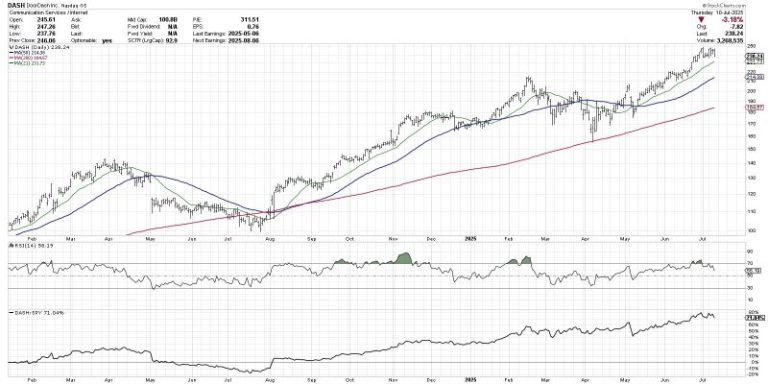
DoorDash Inc. (DASH)

While the mega cap Magnificent 7 stocks like Meta Platforms (META) and Alphabet Inc (GOOGL) tend to grab all the headlines, I’m more intrigued by other names in this sector demonstrating positive technical characteristics.  DoorDash has been making higher highs and higher lows, and remains above three upward-sloping moving averages.

The price is above the 21-day exponential moving average, which is above the 50-day simple moving average, which is above the 200-day simple moving average.  Combined with strong but not excessive momentum, along with improving relative strength, and we have a chart that continues to feature bullish signs in July 2025.

Booking Holdings Inc. (BKNG)

If it seems as if DoorDash is a little too overextended, Booking Holdings is a bit earlier on in its breakout journey.  Here we can see a clear resistance level around $5300, with a breakout and subsequent retest confirming a new uptrend phase.

When a chart like this shows a clear and consistent resistance level, the initial breakout can be quite tempting on the long side.  The subsequent pullback to that same breakout point, followed by new support at the breakout point, serves to validate the breakout and confirm the bullish reading.

With charts like BKNG, I like to use the 21-day exponential moving average as an initial warning sign.  As long as the price remains above this short-term trend mechanism, then the uptrend is still intact.  If and when the price violates this moving average, that’s when I like to review the chart to determine whether the stock still deserves a place in my portfolio.

Boston Scientific Corp. (BSX)

Our final example, Boston Scientific, is one that I would argue still has a bit to prove.  We can observe a clear resistance level around $107.50, which was initially set in February and then retested in May and June.  

This is exactly where I would leverage the Alert Workbench on StockCharts to let me know when the price has finally broken above this crucial resistance level.  I love to save potential breakout candidates to a new ChartList, and then set alerts for if and when the price finally breaks above the entry point.  That way, you’re able to identify an opportunity and develop a simple trading plan up front, and then let StockCharts do the “heavy lifting” and keep a close watch on the price action in the days and weeks to come!

To see the other seven charts in all their glory, head over to the StockCharts TV YouTube channel!

RR#6,

Dave

PS- Ready to upgrade your investment process?  Check out my free behavioral investing course!

David Keller, CMT

President and Chief Strategist

Sierra Alpha Research LLC

marketmisbehavior.com

https://www.youtube.com/c/MarketMisbehavior

Disclaimer: This blog is for educational purposes only and should not be construed as financial advice.  The ideas and strategies should never be used without first assessing your own personal and financial situation, or without consulting a financial professional.  

The author does not have a position in mentioned securities at the time of publication.    Any opinions expressed herein are solely those of the author and do not in any way represent the views or opinions of any other person or entity.

Investing in triple-leveraged ETFs may not be on your radar. But that may change after you watch this video. 

Tom Bowley of EarningsBeats shares how he uses the 3x leveraged ETFs to take advantage of high probability upside moves. Tom shows charts of 3x leveraged ETFs that mirror their benchmark — TNA (Russell 2000), SOXL (Semiconductors), and LABU (Biotech), and maps out how you can use the setups in these charts to multiply your returns. 

With money rotating heavily into growth stocks, investors should be looking for opportunities. Tom shares charts of indexes, sectors, and individual stocks/ETFs that are displaying technical strength and strong accumulation patterns. 

Ready to multiply your returns while the market’s moving higher? Watch Tom chart out the trades he’s making today. 

This video was published on July 10. Click this link to watch on Tom’s dedicated page. 

Missed a session? Archived videos from Tom are available at this link

The words “Get out of Mexico” are still visible on one shop window as protestors violently kicked in the glass pane. In another clip, “Kill a gringo” is spray-painted on a wall in Mexico City as demonstrators carried placards demanding western foreigners “stop stealing our home.”

These were some of the striking scenes at a mass protest last week against gentrification and the rising cost of living in the Mexican capital city, which some have blamed on an influx of foreigners from the United States and Europe.

While the demonstration was largely peaceful and reflected growing anger about inequality in the Mexican capital, those who vandalized stores in the city’s wealthier neighborhoods and used anti-immigration language were criticized by Mexican President Claudia Sheinbaum as being xenophobic.

“No to discrimination, no to racism, no to classism, no to xenophobia, no to machismo, no to discrimination. All human beings, men and women, are equal, and we cannot treat anyone as less,” Sheinbaum said at a Monday press conference.

The US Department of Homeland Security, which has been carrying out an immigration crackdown in the US, reacted to Friday’s protests with an ironic post on X: “If you are in the United States illegally and wish to join the next protest in Mexico City, use the CBP Home app to facilitate your departure.”

The rallies in Mexico City mirror protests that have erupted in cities like Barcelona and Paris against skyrocketing costs, which have been blamed on overtourism, short-term home rentals, and an influx of people and businesses with higher purchasing power.

Frente Anti Gentrificación Mx, one of several groups that helped organize the protest on Friday, compared gentrification on its social media to a new form of colonization in which “the state, institutions, and companies, both foreign and local, provide differential treatment to those with greater purchasing power.”

Anti-gentrification activists say thousands of people in the Mexican capital have been forced out of their homes in recent years as tourists and remote workers, many of whom are believed to be American, take over popular neighborhoods like Roma and Condesa.

But a spokesperson for Frente Anti Gentrificación Mx pushed back against Sheinbaum’s suggestion that their campaign was xenophobic, saying the demonstration was meant to highlight the plight of those priced out of their homes and to demand reforms from the government.

“In Mexico, housing costs have risen 286% since 2005 … while real wages have decreased by 33%,” said Morales, citing data from the National Institute of Statistics and Geography and the Federal Mortgage Society.

She acknowledged that many people have been moving to Mexico for a variety of reasons, from the appeal of its culture to the relative affordability of its houses. At the same time, she urged potential newcomers to consider how such a move could affect the local community.

Not a new phenomenon

Immigration is not the sole cause of Mexico City’s gentrification, which is a phenomenon that has happened for decades, say experts.

“In the debates, there’s a confusion about gentrification being when foreigners arrive. And that’s not true,” activist and lawyer Carla Escoffié said, noting that other causes include inequality, deficiencies in housing policy and land privatization.

“Not all foreigners gentrify, nor are only those who gentrify foreigners, nor is a significant migration process necessary for gentrification to occur. Gentrification is based on inequalities in such a way that it’s not the same thing,” she added.

But the arrival of short-term rentals like Airbnb, and remote work policies during the pandemic, have turbo-charged the gentrification debate in recent years.

“Since 2020, a new phase of gentrification has begun, one that has worsened,” said Escoffié. “It’s been driven by digital nomads and short-term rental platforms like Airbnb.”

Airbnb defended its activities in Mexico City on Tuesday, saying it helped generate more than $1 billion in the local economy last year, and arguing that guests who booked accommodations also spent money on shops and services in the capital.

Mexico City’s government signed an agreement with Airbnb and UNESCO in 2022 to promote the capital as “a global hub for digital nomads and creative tourism.” Sheinbaum, who was the mayor of Mexico City at the time, presented the initiative as a way to boost the local economy.

The appeal was especially attractive for US citizens, who can stay in Mexico without a tourist visa for less than six months before requiring a special temporary residency permit, according to experts. In 2022, 122,758 temporary residency permits were granted to foreigners for Mexico, according to the National Institute of Migration, up from 97,825 in 2019.

But for many residents, the Mexico City initiative was another sign of the displacement happening around them.

A global trend

Anger about gentrification is not unique to Mexico City. Local governments from tourist destinations in Europe, such as Spain’s Canary Islands, Lisbon and Berlin, have announced restrictions on short-term rentals in the past decade.

Barcelona’s leftist mayor, Jaume Collboni, said that by November 2028, the government will scrap the licenses of the 10,101 apartments currently approved as short-term rentals in the popular tourist destination.

Residents in the Catalan capital have documented how renting by the day is more profitable for landlords than renting by the month, which has triggered evictions and the transformation of homes into short-term tourist accommodations.

In Mexico City, Airbnb has over 26,500 listings, according to the rental platform, many of which are concentrated in the areas most affected by gentrification. These listings are concentrated in the central neighborhoods of Condesa, Roma, Juárez and Polanco, according to Inside Airbnb, a project that provides data about Airbnb’s impact on residential communities.

In response to mounting criticism and the protests of 2022, the local government introduced new regulations, but experts argue they fall far short.

Airbnb, meanwhile, says the city needs regulations that support home sharing, not prohibition. It argues that many people in Mexico City rely on the platform as a financial lifeline, with 53% of its hosts saying the service helped them stay in their homes and 74% of hosts saying it helped cover essential expenses.

Activists are now bracing for when Mexico opens its doors to soccer fans for the next World Cup in 2026, which Morales fears could result in the state prioritizing business dealings over residents. “Given the critical state we’re in, who would come up with this?” she asked.

This post appeared first on cnn.com

European Commission President Ursula von der Leyen survived a no-confidence vote in the European Parliament on Thursday, brought by mainly far-right lawmakers who alleged she and her team undermined trust in the EU through unlawful actions.

As expected, the motion failed to get the two-thirds majority it needed to pass. Only 175 members of parliament backed the motion, while 360 voted against and 18 abstained.

Romanian nationalist Gheorghe Piperea, the lead sponsor of the motion, had criticized among other things the Commission’s refusal to disclose text messages between von der Leyen and the chief executive of vaccine maker Pfizer during the COVID-19 pandemic.

“The decision-making has become opaque and discretionary, and raises fears of abuse and corruption. The cost of obsessive bureaucracy of the European Union such as (tackling) climate change has been a huge one,” Piperea told the parliament on Monday.

During the debate on her leadership, von der Leyen defended her record in parliament, rejecting criticism of her management of the pandemic and asserting that her approach ensured equal vaccine access across the EU.

Although the censure motion had little chance of success, it was a political headache for von der Leyen as her Commission negotiates with US President Donald Trump’s administration to try to prevent steep US tariffs on EU goods.

It was the first time since 2014 that a Commission president has faced such a motion. Then President Jean-Claude Juncker also survived the vote.

This post appeared first on cnn.com

The remains of a famous sycamore tree, which stood on Britain’s Roman-built Hadrian’s Wall in northern England for more than 200 years, has found a new home nearly two years after it was illegally felled.

The removal of the tree from its spot known as “Sycamore Gap,” a pronounced dip in Hadrian’s Wall, in September 2023 sparked global outrage. Sycamore Gap was considered one of the most photographed trees in England and was made famous to millions when it appeared in Kevin Costner’s 1991 blockbuster film “Robin Hood: Prince Of Thieves.”

In May, two men were found guilty of criminal damage for felling the landmark tree.

Now, a section of it will be put on permanent display at The Sill: National Landscape Discovery Centre, about two miles (three kilometers) from where it once stood.

The UK’s National Trust gave the largest remaining piece of the salvaged trunk to the Northumberland National Park, where the tree was located.

“In the days and months after the tree was felled, The Sill became a place of celebration and memory. Visitors left post-it notes, letters, drawings and messages expressing grief, love, and hope,” the park said in a press release Thursday.

A public consultation was held in the aftermath of the felling on the future of the tree trunk. “The resulting exhibit honours the tree’s natural form while inviting people to engage with it in a deeply personal way,” The Sill said in a press release Thursday.

Tree trunk ‘is huggable’

The trunk is positioned upright, as it once was, and is surrounded by tree oak benches and streams of wood bent to form a canopy in the shape of a huge leaf – recreating the shelter the tree once offered for people to sit and reflect.

Some tributes from the local community have been carved into the wood.

“The original tree may be gone in the form we knew it, but its legacy remains, and what has come since has been endlessly positive, affirming our belief that people nature and place cannot be separated and are interdependent,” said Tony Gates, chief executive of Northumberland National Park Authority, in the release.

“This commission has been the biggest honour of my career,” said Charlie Whinney, the artist behind the new exhibition, in the release.

“I really hope what we’ve done in some small way allows the people of Northumberland and those who held this tree close to their hearts to process the loss they still feel from that day in September 2023, when the tree was illegally cut down,” he added.

“The work looks forward with hope, the tree is regrowing, and Sycamore Gap will always be a magical place to visit,” Whinney continued.

This post appeared first on cnn.com

President Donald Trump’s budget chief on Thursday said that Federal Reserve Chairman Jerome Powell “has grossly mismanaged the Fed” and suggested he had misled Congress about a pricey and “ostentatious” renovation of the central bank’s headquarters.

The broadside by Office of Management and Budget Director Russell Vought opened up a new front in Trump’s war of words against Powell.

Trump has repeatedly called on the Fed chairman to cut interest rates, without success. He reportedly has considered firing Powell and, more recently, publicly naming the chairman’s replacement months earlier than the end of Powell’s term next spring.

Vought’s letter raises the question of whether Trump will seek to remove Powell for cause, at least ostensibly.

But the Supreme Court in a recent decision strongly suggested that Federal Reserve board members have special protection from being fired by a president.

“While continuing to run a deficit since FY23 (the first time in the Fed’s history), the Fed is way over budget on the renovation of its headquarters,” Vought wrote in a post on the social media site X.

“Now up to $2.5 billion, roughly $700 million over its initial cost,” Vought wrote. “The cost per square foot is $1,923–double the cost for renovating an ordinary historic federal building. The Palace of Versailles would have cost $3 billion in today’s dollars!”

Vought’s tweet linked to a letter he sent Powell that referenced the Fed boss’s June 25 testimony before the Senate Banking Committee.

“Your testimony raises serious questions about the project’s compliance with the National Capital Planning Act, which requires that projects like the Fed headquarters renovation be approved by the National Capital Planning Commission,” Vought wrote.

“The plans for this project called for rooftop terrace gardens, VIP private dining rooms and elevators, water features, premium marble, and much more,” he wrote.

But Powell, in his testimony, said, “There’s no VIP dining room. There’s no new marble. There are no special elevators. There are no new water features. There’s no beehives and there’s no roof terrace gardens,” Vought wrote.

“Although minor deviations from approved plans may be inevitable, your testimony appears to reveal that the project is out of compliance with the approved plan with regard to major design elements,” Vought wrote.

This post appeared first on NBC NEWS

Oak View Group CEO Tim Leiweke was indicted on a federal criminal conspiracy charge related to allegedly rigging a bid to develop, manage, and operate the University of Texas’ basketball and entertainment arena in Austin, the Department of Justice said Wednesday.

Oak View Group, which will pay $15 million in penalties in connection with the allegations, later Wednesday said that Leiweke “will transition from the position of CEO to” vice chairman of the entertainment venue giant’s board of directors, and remain a shareholder.

Leiweke, 68, is accused in the indictment of conspiring with another would-be bidder on UT’s $338 million Moody Center arena project to induce that second company in February 2018 to drop out of the competition with Oak View Group in exchange for receiving lucrative subcontracts at the 15,000-seat arena.

CNBC has been told the second company was Legends Hospitality, a New York-based venue services company that is majority-owned by Sixth Street Partners, and whose minority owners include the New York Yankees and the Dallas Cowboys.

The indictment in U.S. District Court in Austin says that Leiweke later reneged on that promise to the second company after it dropped its effort to bid on the entire project.

“The arena opened to the public in April 2022, and OVG continues to receive significant revenues from the project to date,” the Department of Justice said Wednesday.

Leiweke “rigged a bidding process to benefit his own company and deprived a public university and taxpayers of the benefits of competitive bidding,” said Assistant Attorney General Abigail Slater of the DOJ’s Antitrust Division, in a statement.

Leweike, in a 2022 interview with CNBC, said that the Moody Center was one of his company’s “two most successful arenas.”

The DOJ also said Wednesday that Oak View Group and Legends agreed to pay $15 million and $1.5 million, respectively, in penalties “in connection with the conduct alleged in the indictment against Leiweke.”

Oak View Group’s website says that the company manages 400 sports, entertainment and other venues.

Lewieke, who is charged with one count of conspiracy to restrain trade, is the former CEO of Maple Leaf Sports and Entertainment. Before that, he served as CEO of Anschutz Entertainment Group.

A spokesman for Leiweke, in a statement to CNBC, said, “Mr. Leiweke has done nothing wrong and will vigorously defend himself and his well-deserved reputation for fairness and integrity.”

“The Antitrust Division’s allegations are wrong on the law and the facts, and the case should never have been brought,” the spokesman said. “The law is clear: vertical, complementary business partnerships, like the one contemplated between OVG and Legends, are legal.”

“These allegations blatantly ignore established legal precedent and seek to criminalize common teaming efforts that are proven to enhance competition and benefit the public. The Moody Center is a perfect example, as it has resulted in substantial and sustained benefits to the University of Texas and the City of Austin.”

Leiweke, in his own statement, said, “While I’m pleased the company has resolved its Department of Justice Antitrust Division inquiry without any charges filed or admission of wrongdoing, the last thing I want to do is distract from the accomplishments of the team or draw focus away from executing for our partners, so the Board and I decided that now is the right time to implement the succession plan that was already underway and transition out of the CEO role.

Oak View Group, in a statement, said, “Oak View Group cooperated fully with the Antitrust Division’s inquiry and is pleased to have resolved this matter with no charges filed against OVG and no admission of fault or wrongdoing.”

“We support all efforts to ensure a fair and competitive environment in our industry and are committed to upholding industry-leading compliance and disclosure practices,” Oak View Group said.

CNBC has requested comment from Legends.

Chris Granger, who was president of Oak View Group’s division OVG360, has been appointed as interim CEO of Oak View Group by the company’s board.

Granger previously was group president for sports and entertainment of the Detroit Tigers and Detroit Red Wings, and president and chief operating officer of the Sacramento Kings.

This post appeared first on NBC NEWS

SAN FRANCISCO — OpenAI is close to releasing an AI-powered web browser that will challenge Alphabet’s market-dominating Google Chrome, three people familiar with the matter told Reuters.

The browser is slated to launch in the coming weeks, three of the people said, and aims to use artificial intelligence to fundamentally change how consumers browse the web. It will give OpenAI more direct access to a cornerstone of Google’s success: user data.

If adopted by the 500 million weekly active users of ChatGPT, OpenAI’s browser could put pressure on a key component of rival Google’s ad-money spigot. Chrome is an important pillar of Alphabet’s ad business, which makes up nearly three-quarters of its revenue, as Chrome provides user information to help Alphabet target ads more effectively and profitably, and also gives Google a way to route search traffic to its own engine by default.

OpenAI’s browser is designed to keep some user interactions within a ChatGPT-like native chat interface instead of clicking through to websites, two of the sources said.

The browser is part of a broader strategy by OpenAI to weave its services across the personal and work lives of consumers, one of the sources said.

OpenAI declined to comment. The sources declined to be identified because they are not authorized to speak publicly on the matter. Led by entrepreneur Sam Altman, OpenAI upended the tech industry with the launch of its AI chatbot ChatGPT in late 2022. After its initial success, OpenAI has faced stiff competition from rivals including Google and startup Anthropic, and is looking for new areas of growth.

In May, OpenAI said it would enter the hardware domain, paying $6.5 billion to buy io, an AI devices startup from Apple’s former design chief, Jony Ive. A web browser would allow OpenAI to directly integrate its AI agent products such as Operator into the browsing experience, enabling the browser to carry out tasks on behalf of the user, the people said.

The browser’s access to a user’s web activity would make it the ideal platform for AI “agents” that can take actions on their behalf, like booking reservations or filling out forms, directly within the websites they use.

OpenAI has its work cut out — Google Chrome, which is used by more than 3 billion people, currently holds more than two-thirds of the worldwide browser market, according to web analytics firm StatCounter. Apple’s second-place Safari lags far behind with a 16% share. Last month, OpenAI said it had 3 million paying business users for ChatGPT.

Perplexity, which has a popular AI search engine, launched an AI browser, Comet, on Wednesday, capable of performing actions on a user’s behalf. Two other AI startups, The Browser Company and Brave, have released AI-powered browsers capable of browsing and summarizing the internet.

Chrome’s role in providing user information to help Alphabet target ads more effectively and profitably has proven so successful that the Department of Justice has demanded its divestiture after a U.S. judge last year ruled that the Google parent holds an unlawful monopoly in online search.

OpenAI’s browser is built atop Chromium, Google’s own open-source browser code, two of the sources said. Chromium is the source code for Google Chrome, as well as many competing browsers including Microsoft’s Edge and Opera. Last year, OpenAI hired two longtime Google vice presidents who were part of the original team that developed Google Chrome. The Information was first to report their hires and that OpenAI previously considered building a browser.

An OpenAI executive testified in April that the company would be interested in buying Chrome if antitrust enforcers succeeded in forcing the sale. Google has not offered Chrome for sale. The company has said it plans to appeal the ruling that it holds a monopoly.

OpenAI decided to build its own browser, rather than simply a “plug-in” on top of another company’s browser, in order to have more control over the data it can collect, one source said.

This post appeared first on NBC NEWS


Stallion Uranium Corp. (the ‘ Company ‘ or ‘ Stallion ‘ ) ( TSX-V: STUD ; OTCQB: STLNF ; FSE: FE0 ) announces that further to its news release of July 8, 2025, announcing that it had entered into a technology data acquisition agreement, the Company clarifies that the technology licensing agreement is dated effective July 7, 2025 and not April 24, 2025. For further information in respect of this transaction, please refer to the Company’s news release of July 8, 2025.


  About Stallion Uranium Corp.:  


 Stallion Uranium is working to ‘Fuel the Future with Uranium’ through the exploration of roughly 1,700 sq/km in the Athabasca Basin, home to the largest high-grade uranium deposits in the world. The company, with JV partner Atha Energy holds the largest contiguous project in the Western Athabasca Basin adjacent to multiple high-grade discovery zones.


Our leadership and advisory teams are comprised of uranium and precious metals exploration experts with the capital markets experience and the technical talent for acquiring and exploring early-stage properties. For more information visit stallionuranium.com .


  On Behalf of the Board of Stallion Uranium Corp.:  


Matthew Schwab
CEO and Director


  Corporate Office:  
700 – 838 West Hastings Street,
Vancouver, British Columbia,
V6C 0A6


T: 604-551-2360
info@stallionuranium.com  


  Neither the TSX Venture Exchange nor its Regulation Services Provider (as that term is defined in the policies of the TSX Venture Exchange) accepts responsibility for the adequacy or accuracy of this release.  


  This news release contains forward-looking statements and forward-looking information within the meaning of Canadian securities legislation (collectively, ‘forward-looking statements’) that relate to the Company’s current expectations and views of future events. Any statements that express, or involve discussions as to, expectations, beliefs, plans, objectives, assumptions or future events or performance (often, but not always, through the use of words or phrases such as ‘will likely result’, ‘are expected to’, ‘expects’, ‘will continue’, ‘is anticipated’, ‘anticipates’, ‘believes’, ‘estimated’, ‘intends’, ‘plans’, ‘forecast’, ‘projection’, ‘strategy’, ‘objective’ and ‘outlook’) are not historical facts and may be forward-looking statements and may involve estimates, assumptions and uncertainties which could cause actual results or outcomes to differ materially from those expressed in such forward-looking statements. No assurance can be given that these expectations will prove to be correct and such forward-looking statements included in this material change report should not be unduly relied upon. These statements speak only as of the date they are made.  


  Forward-looking statements are based on a number of assumptions and are subject to a number of risks and uncertainties, many of which are beyond the Company’s control, which could cause actual results and events to differ materially from those that are disclosed in or implied by such forward-looking statements. The Company undertakes no obligation to update or revise any forward-looking statements, whether as a result of new information, future events or otherwise, except as may be required by law. New factors emerge from time to time, and it is not possible for the Company to predict all of them or assess the impact of each such factor or the extent to which any factor, or combination of factors, may cause results to differ materially from those contained in any forward-looking statement. Any forward-looking statements contained in this presentation are expressly qualified in their entirety by this cautionary statement .


News Provided by GlobeNewswire via QuoteMedia

This post appeared first on investingnews.com