Author

admin

Browsing

In the past 48 hours, the Middle East has witnessed an unprecedented US airstrike on Iran with its most powerful non-nuclear weapons, an Iranian retaliatory strike on the largest US air base in the region, to an apparent truce that will see Iran and Israel end their hostilities that have set the world on edge.

The region and the wider world watched warily as events unfolded overnight into Tuesday, but with a degree of hope as daylight broke in the region that what US President Donald Trump called the “12 Day War” may be over.

“THE CEASEFIRE IS NOW IN EFFECT. PLEASE DO NOT VIOLATE IT!” Trump wrote on his Truth Social account.

Around the same time, Israeli emergency workers were at the site of what appeared to be Iran’s final attack of the 12-day conflict, a missile strike in Beer Shiva that left at least five people dead and 20 wounded.

It could be the last hostile act of two days of whipsawing developments leading up to Trump’s surprise announcement of a ceasefire.

Here’s the situation Tuesday in the Middle East.

The ceasefire deal

On Monday evening in Washington, the US president announced the ceasefire.

“It has been fully agreed by and between Israel and Iran that there will be a Complete and Total CEASEFIRE,” Trump said in a social media post.

“I would like to congratulate both Countries, Israel and Iran, on having the Stamina, Courage, and Intelligence to end, what should be called, “THE 12 DAY WAR,” Trump said.

Trump said the ceasefire would be phased in, with Iran ending attacks on Israel first, then Israel stopping its attacks on Iran 12 hours later. But the exact timing of those events was unclear.

During the negotiations, Trump communicated directly with Israeli Prime Minister Benjamin Netanyahu, while Vice President JD Vance, Secretary of State and National Security Adviser Marco Rubio and special envoy Steve Witkoff negotiated the terms, through direct and indirect channels, with the Iranians, the source said.

Trump said in a later social media post that both Israel and Iran came to him to get a ceasefire done.

Iranian state media reported, however, that Trump sought the ceasefire deal “in a begging-like manner” after the attack on the US air base in Qatar.

Whether a ceasefire will hold remains to be seen.

Around the time Iran was supposed to have stopped its attacks under the Trump timeline, its missiles hit Israel, killing at least five civilians, according to Israeli officials.

Iran fires on biggest US base in region

Just hours before Trump’s ceasefire announcement, Iran fired about a dozen short- and medium-range ballistic missiles at the Al Udeid Air Base in Qatar, the largest US military installation in the Middle East.

But Tehran tipped both the US and Qatar that the strike was coming, and air defenses, including Patriot missile batteries, were able to intercept all but one of the incoming Iranian missiles, according to US and Qatari officials. No deaths or injuries were reported in Qatar.

In a social media post, Trump thanked Iran for warning the missile attack was coming.

“Most importantly, they’ve gotten it all out of their ‘system,’ and there will, hopefully, be no further HATE. I want to thank Iran for giving us early notice, which made it possible for no lives to be lost, and nobody to be injured,” Trump said.

“Tehran’s choice to limit its retaliation and deescalate the crisis is rational on their part given overwhelming US strength and Iranian weakness,” said Rosemary Kelanic, director of the Middle East Program at Defense Priorities.

What about Iran’s nuclear program?

Israel’s contention that Iran would soon be able to build a nuclear weapon was the impetus for the conflict, which began with Israel Defense Forces strikes on Iranian nuclear facilities and against Iran’s military and nuclear program scientists on the night of June 12-13.

Trump followed on Israel’s airstrikes by ordering an attack on Iranian nuclear facilities, including a fleet of US B-2 bombers to dropping fourteen 30,000-pound Massive Ordnance Penetrator bombs on two deeply buried sites in Iran, the first time weapon had been used in combat.

Trump administration officials said Iran’s nuclear weapons program, which they said was just days away from the ability to make a nuclear bomb, was set back years by the US strikes.

Experts were more skeptical, saying Iranian stores of enriched uranium may have escaped destruction in the US strikes and Tehran may be able to make a weapon in just a few months.

What now for Gaza?

The Middle East has been a tinderbox since October 2023, when Hamas militants from Gaza entered Israel in force, killing hundreds and taking dozens more hostage.

Israel responded with an invasion of the Palestinian enclave to root out Hamas from tunnels and other fortifications that has left over 55,000 people dead, much of Gaza in ruins and its population of 2.1 million at risk of famine, according to the World Health Organization.

While the world’s attention has been on Israel’s fighting with Iran, dozens of people have been killed by Israeli forces in Gaza as they scramble to get the limited food aid allowed into the territory, including 21 in the past day, Palestinians say.

A group advocating for the return of Israeli hostages held in Gaza has called for the ceasefire between Israel and Iran to be expanded to include the war-torn enclave.

“Those who can achieve a ceasefire with Iran can also end the war in Gaza,” the Hostages and Missing Families Forum said in a statement Tuesday.

The forum said the ceasefire “must expand to include Gaza” and called on the government “to engage in urgent negotiations that will bring home all the hostages and end the war.”

“After 12 days and nights during which the people of Israel could not sleep because of Iran, we can finally go back to not sleeping because of the hostages,” the forum said.

Israeli opposition leader Yair Lapid echoed those sentiments, writing in a post on X: “And now Gaza. This is the moment to close that front as well. To bring the hostages home, to end the war. Israel needs to start rebuilding.”

This post appeared first on cnn.com

White Cliff Minerals Limited (“WCN” or the “Company”) (ASX: WCN; OTCQB: WCMLF) is pleased to announce that John Hancock will join the Board of White Cliff Minerals effective 1 August 2025.

The Company is also pleased to announce that is has entered an advisory mandate with John Hancock’s family office Astrotricha Capital SEZC with Gavin Rezos as its CEO. This engagement, alongside John’s appointment to the Board comes at a pivotal time for White Cliff as its highly anticipated follow up campaign at the Rae Copper Project will shortly commence.

“Alongside our brokers, we have now worked with our Strategic Advisor John Hancock and his family office Astrotricha Capital on two successful capital raises totalling more than A$15m. We now welcome John to the Company as a Non-Executive Director who, alongside Astrotricha CEO Gavin Rezos, will bring further industry experience and strategic advice as we embark on the next phase of exploration at our Rae Copper Project where we will shortly commence drilling at the high-grade Danvers deposit and the giant geophysical anomaly at the sedimentary target – Hulk.’

Troy Whittaker – Managing Director

‘White Cliff’s first mover advantage in what may be one of the most prospective copper regions globally led to my involvement as Strategic Advisor and then via on-market purchases and the capital raises, to become the Company’s largest shareholder. The Company is well-funded to shortly commence the large drill campaign at Rae as a follow on from our earlier world class intercepts at the Danvers deposit. I am pleased Gavin Rezos, via Astrotricha Capital SEZC, will provide his extensive experience and networks to compliment my own contribution.’

John Hancock – Incoming Non-Executive Director

John’s experience in the mining and exploration industry began more than 40 years ago visiting Pilbara iron ore prospects with his grandfather, Lang Hancock. During the 1990s he was part of marketing missions representing the Hope Downs Iron Ore project to customers and investors in China, Japan and Germany, including co-presenting the project at the 1997 Iron and Steel Conference held in Berlin. After two years working in South Africa with Iscor Mining (now Kumba) and on return to Australia completing an MBA, John transitioned to the role of investor and over the last 20 years has built a record of successful early-stage investments in Lithium and Uranium, including substantial holdings in Vulcan Energy and Aura Energy. His experience in international resource development and capital markets includes the role of Senior Advisor to a New York based fund that during his tenure has deployed more than $500m to small-cap companies in both Australia and Canada, particularly within the mining industry.

‘Astrotricha has introduced high net worth investors and funds from Australia and globally to the WCN register. Our combined successful track record in assisting the development of resource projects and many years’ experience in international capital markets, corporate advisory, project development and corporate governance has attracted a range of co investors, both financial and strategic, ready to follow Astrotricha into new companies as those companies develop and their market capitalisation grows. Astrotricha’s aim is to invest at an early stage into potential Tier 1 resource companies and assist them over the development journey. White Cliff was identified as a prime candidate by John Hancock in 2024.”

Gavin Rezos – CEO Astrotricha Capital SEZC

Gavin Rezos has extensive Australian and international investment banking, corporate advisory and governance experience and is a former Investment Banking Director of HSBC Group with regional roles during his career based in London, Sydney and Dubai. Admitted as a solicitor in Australia and England, Gavin has been legal advisor for HSBC on transactions in Australasia, Europe, Latin America and the Middle East. Gavin has held Chairman, Board and CEO positions of public companies in the resources, materials and technology sectors in Australia, the UK, Germany and the US and during these tenures raised a total of over $1.8 billion for project development. Gavin is the former Chairman of Vulcan Energy Resources, non-executive director of Iluka Resources and of Rowing Australia, the peak Olympics sports body for rowing in Australia. As an early-stage founder director, Gavin has taken 3 companies from start up to the ASX300 and one to a market capitalisation of over $1 billion.

Director Retirement

Daniel Smith has informed the Board of his intent to retire as a director of White Cliff to focus on his other professional interests from 1 August 2025. The Board is grateful to Dan for his contribution to White Cliff over the last 5 years and wishes him all the best in his future endeavours.

Click here for the full ASX Release

This post appeared first on investingnews.com

Apple was sued on Friday by shareholders in a proposed securities fraud class action that accused it of downplaying how long it needed to integrate advanced artificial intelligence into its Siri voice assistant, hurting iPhone sales and its stock price.

The complaint covers shareholders who suffered potentially hundreds of billions of dollars of losses in the year ending June 9, when Apple introduced several features and aesthetic improvements for its products but kept AI changes modest.

Apple did not immediately respond to requests for comment.

CEO Tim Cook, Chief Financial Officer Kevan Parekh and former CFO Luca Maestri are also defendants in the lawsuit filed in San Francisco federal court.

Shareholders led by Eric Tucker said that at its June 2024 Worldwide Developers Conference, Apple led them to believe AI would be a key driver of iPhone 16 devices, when it launched Apple Intelligence to make Siri more powerful and user-friendly. But they said the Cupertino, California-based company lacked a functional prototype of AI-based Siri features and could not reasonably believe the features would ever be ready for iPhone 16s.

Shareholders said the truth began to emerge on March 7 when Apple delayed some Siri upgrades to 2026 and continued through this year’s Worldwide Developers Conference on June 9 when Apple’s assessment of its AI progress disappointed analysts.

Apple shares have lost nearly one-fourth of their value since their Dec. 26, 2024 ,record high, wiping out approximately $900 billion of market value.

This post appeared first on NBC NEWS

(TheNewswire)

TORONTO, ON TheNewswire – June 24, 2025 –Silver Crown Royalties Inc. (‘ Silver Crown ‘, ‘ SCRi ‘, the ‘ Corporation ‘, or the ‘ Company ‘) (Cboe:SCRI; OTCQX:SLCRF; FRA:QS0) is pleased to announce that the Company has successfully closed the first tranche (‘ First Tranche ‘) of its non-brokered offering of units of the Company (‘ Units ‘) for gross proceeds of up to $2,000,000 that was previously announced on May 20, 2025 (the ‘ Offering ‘). The Company issued 102,838 Units at a price of C$6.50 per Unit pursuant to the First Tranche for gross proceeds of approximately C$668,447.

Each Unit consists of one common share (‘ Common Share ‘) and one Common Share purchase warrant (‘ Warrant ‘), with each Warrant exercisable to acquire one additional Common Share at an exercise price of C$13.00 for a period of three years from the date hereof.

The proceeds from the First Tranche will be used to fund the Company’s silver royalty acquisition on the Igor 4 project in Peru, as well as general and administrative expenses. All securities issued are subject to a statutory hold period of four months plus one day from the date of issuance, in accordance with applicable securities legislation. The closing was subject to customary conditions, including the approval of Cboe Canada Inc.

The Company is also pleased to announce it is extending the closing of an additional tranche of the Offering to July 11, 2025.

ABOUT Silver Crown Royalties INC.

Founded by industry veterans, Silver Crown Royalties ( Cboe: SCRI | OTCQX: SLCRF | BF: QS0 ) is a publicly traded, silver royalty company. Silver Crown (SCRi) currently has four silver royalties of which three are revenue-generating. Its business model presents investors with precious metals exposure that allows for a natural hedge against currency devaluation while minimizing the negative impact of cost inflation associated with production. SCRi endeavors to minimize the economic impact on mining projects while maximizing returns for shareholders. For further information, please contact:

Silver Crown Royalties Inc.

Peter Bures, Chairman and CEO

Telephone: (416) 481-1744

Email: pbures@silvercrownroyalties.com

FORWARD-LOOKING STATEMENTS

This release contains certain ‘forward looking statements’ and certain ‘forward-looking information’ as defined under applicable Canadian and U.S. securities laws. Forward-looking statements and information can generally be identified by the use of forward-looking terminology such as ‘may’, ‘will’, ‘should’, ‘expect’, ‘intend’, ‘estimate’, ‘anticipate’, ‘believe’, ‘continue’, ‘plans’ or similar terminology. The forward-looking information contained herein is provided for the purpose of assisting readers in understanding management’s current expectations and plans relating to the future. Readers are cautioned that such information may not be appropriate for other purposes. Forward-looking statements and information include, but are not limited to, the proceeds from the First Tranche will be used to fund the Company’s silver royalty acquisition on the Igor 4 project in Peru, as well as general and administrative expenses. Forward-looking statements and information are based on forecasts of future results, estimates of amounts not yet determinable and assumptions that, while believed by management to be reasonable, are inherently subject to significant business, economic and competitive uncertainties and contingencies. Forward-looking information is subject to known and unknown risks, uncertainties and other factors that may cause the actual actions, events or results to be materially different from those expressed or implied by such forward-looking information, including but not limited to: the impact of general business and economic conditions; the absence of control over mining operations from which SCRi will purchase gold and other metals or from which it will receive royalty payments and risks related to those mining operations, including risks related to international operations, government and environmental regulation, delays in mine construction and operations, actual results of mining and current exploration activities, conclusions of economic evaluations and changes in project parameters as plans continue to be refined; accidents, equipment breakdowns, title matters, labor disputes or other unanticipated difficulties or interruptions in operations; SCRi’s ability to enter into definitive agreements and close proposed royalty transactions; the inherent uncertainties related to the valuations ascribed by SCRi to its royalty interests; problems inherent to the marketability of gold and other metals; the inherent uncertainty of production and cost estimates and the potential for unexpected costs and expenses; industry conditions, including fluctuations in the price of the primary commodities mined at such operations, fluctuations in foreign exchange rates and fluctuations in interest rates; government entities interpreting existing tax legislation or enacting new tax legislation in a way which adversely affects SCRi; stock market volatility; regulatory restrictions; liability, competition, the potential impact of epidemics, pandemics or other public health crises on SCRi’s business, operations and financial condition, loss of key employees. SCRi has attempted to identify important factors that could cause actual results to differ materially from those contained in forward-looking statements, there may be other factors that cause results not to be as anticipated, estimated or intended. There can be no assurance that such statements will prove to be accurate, as actual results and future events could differ materially from those anticipated in such statements. Accordingly, readers are advised not to place undue reliance on forward-looking statements or information. SCRi undertakes no obligation to update forward-looking information except as required by applicable law. Such forward-looking information represents management’s best judgment based on information currently available.

This document does not constitute an offer to sell, or a solicitation of an offer to buy, securities of the Company in Canada, the United States or any other jurisdiction. Any such offer to sell or solicitation of an offer to buy the securities described herein will be made only pursuant to subscription documentation between the Company and prospective purchasers. Any such offering will be made in reliance upon exemptions from the prospectus and registration requirements under applicable securities laws, pursuant to a subscription agreement to be entered into by the Company and prospective investors. There can be no assurance that forward-looking statements will prove to be accurate, as actual results and future events could differ materially from those anticipated in such statements. Accordingly, the reader is cautioned not to place undue reliance on forward-looking statements.

CBOE CANADA DOES NOT ACCEPT RESPONSIBILITY FOR THE ADEQUACY OR ACCURACY OF THIS NEWS RELEASE.

Copyright (c) 2025 TheNewswire – All rights reserved.

News Provided by TheNewsWire via QuoteMedia

This post appeared first on investingnews.com

Here’s a quick recap of the crypto landscape for Monday (June 23) as of 9:00 p.m. UTC.

Get the latest insights on Bitcoin, Ethereum and altcoins, along with a round-up of key cryptocurrency market news.

Bitcoin and Ethereum price update

Bitcoin (BTC) is priced at US$102,876, an increase of 4.2 percent in the last 24 hours. The day’s range for the cryptocurrency brought a low of US$100,177 and a high of US$103,154 as the market opened.

Bitcoin price performance, June 23, 2025.

Chart via TradingView.

Crypto markets are bracing for continued short-term volatility, heavily influenced by macro conditions and geopolitical developments, particularly the US-Iran situation. Traders are warning of a potential drop to US$95,000, with some even anticipating US$92,000, as only 3 percent of newer Bitcoin investors are currently profitable.

Despite immediate concerns, analysts remain constructive on Bitcoin’s long-term resilience. Growing structural demand from public entities is solidifying Bitcoin’s role as a strategic reserve. Longer-term metrics suggest 2025 could be the last bullish leg of this cycle, potentially driving Bitcoin prices north of US$200,000.

Over the weekend, Bitcoin fell below the US$100,000 mark for the first time since May following US President Donald Trump’s announcement that the US had bombed three of Iran’s main nuclear facilities.

The airstrikes, which reportedly targeted Fordow, Natanz, and Isfahan, heightened investor risk aversion, triggering over US$1 billion in liquidations across crypto markets. Derivatives data from Coinglass shows that US$915 million of long positions and US$109 million worth of shorts were wiped out.

Ethereum (ETH) closed at US$2,308.07, a 6 percent increase over the past 24 hours. Its lowest valuation on Monday was US$2,206.39, and its highest valuation was US$2,312.59, minutes before the closing bell.

Altcoin price update

  • Solana (SOL) was priced at US$139, up 8.1 percent over 24 hours and its highest valuation for Monday. SOL experienced a low of US$131.53 during the day.
  • XRP also reached its highest daily valuation at the closing bell. It traded at US$2.05 as markets wrapped, up by 5 percent in 24 hours. The cryptocurrency’s lowest valuation was US$1.97.
  • Sui (SUI) is trading at US$2.61, showing an increaseof 11.7 percent over the past 24 hours. Its lowest valuation was US$2.42, and it reached its highest valuation at the closing bell.
  • Cardano (ADA) is priced at US$0.5527, up 5.7 percent in 24 hours to its highest value. Its lowest valuation on Monday was US$0.5315.

Today’s crypto news to know

Pompliano launches US$1 billion Bitcoin treasury firm

Crypto investor Anthony Pompliano has unveiled a new Bitcoin treasury company, ProCap Financial, via a merger with Columbus Circle Capital I, a special purpose acquisition company.

The venture will hold up to US$1 billion in Bitcoin, and aims to follow in the footsteps of Michael Saylor’s Strategy (NASDAQ:MSTR), a software firm turned crypto juggernaut.

ProCap has already raised US$500 million in equity and secured a US$250 million convertible note in what Pompliano has called the largest-ever raise for a treasury-focused crypto firm.

Unlike traditional holdings strategies, ProCap intends to actively generate revenue from its Bitcoin through lending, derivatives and financial services.

Metaplanet buys US$117 million worth of Bitcoin

Tokyo-based Metaplanet (TSE:3350,OTCQX:MTPLF) has added 1,111 BTC to its reserves, spending roughly US$117 million during a weekend dip sparked by US-Iran tensions.

The firm purchased the Bitcoin at an average price of US$105,681 per coin, increasing its total holdings to 11,111 BTC valued at over US$1.1 billion. Metaplanet has embraced a bold Bitcoin-first treasury approach, positioning itself as Asia’s Strategy equivalent in the corporate crypto playbook.

OKX considers US IPO

Cryptocurrency exchange OKX is reportedly considering an initial public offering (IPO) in the US, according to an interview the Information conducted with an executive from the firm on Sunday (June 22).

“We will absolutely consider an IPO in the future,” Haider Rafique, chief marketing officer, told the outlet, without providing a potential launch date. “If we go public, it would likely be in the U.S.”

The exchange resumed operations in the US in April after the US Department of Justice found that it had actively pursued US customers without the required license. OKX pleaded guilty to one count of operating an unlicensed money transmitting business in February and agreed to pay over US$500 million in penalties.

Sequans plans Bitcoin treasury raise

Sequans Communications (NYSE:SQNS), an IoT semiconductor developer, is planning a US$384 million capital raise for a strategic Bitcoin treasury. This move is one of the latest in a growing trend of companies using Bitcoin as a reserve asset, which crypto analyst Adam Back has dubbed the “new ALT SZN for speculators.’

The company issued a press release announcing the endeavor on Monday.

The raise includes US$195 million in equity and US$189 million in convertible debentures. The company is also partnering with Swan Bitcoin for its Bitcoin treasury management. CEO Georges Karam said this reflects “strong conviction in bitcoin as a premier asset and a compelling long-term investment.”

Fiserv to roll out Stablecoin platform for 3,000 US banks

Payments giant Fiserv (NYSE:FISV) is entering the stablecoin market with FIUSD, a new digital dollar offering aimed at thousands of main street banks. The platform will allow Fiserv’s banking clients — estimated at 3,000 institutions — to launch their own branded stablecoins or integrate FIUSD into their operations.

Built on top of Fiserv’s existing payments infrastructure, the platform will be interoperable with major blockchains and other stablecoins, including Circle’s (NYSE:CRCL) USDC and Paxos.

The platform is set to go live by the end of the year.

Canaan completes US pilot production, exits AI business

In a statement sent to Cointelegraph on Monday morning, a representative from Canaan (NASDAQ:CAN), a tech firm primarily known for designing and producing application-specific integrated circuits (ASICs) for Bitcoin mining, said it “has successfully completed a pilot production run in the US.” Canaan also announced the discontinuation of its artificial intelligence semiconductor business in what it said is “a strategic realignment aimed at sharpening its focus.”

“I believe that doubling down on our core strengths in crypto infrastructure and Bitcoin mining is the most strategic path forward for Canaan,” said Nangeng Zhang, chairman and CEO of Canaan.

Securities Disclosure: I, Giann Liguid, hold no direct investment interest in any company mentioned in this article.

Securities Disclosure: I, Meagen Seatter, hold no direct investment interest in any company mentioned in this article.

This post appeared first on investingnews.com

In today’s “Weekly Market Recap”, EarningsBeats.com’s Chief Market Strategist Tom Bowley looks ahead to determine the likely path for U.S. equities after the weekend bombing of Iran nuclear sites. Are crude prices heading higher? Will energy stocks outperform? What additional roadblocks might we have to negotiate after the latest Fed meeting and policy statement? Could we see fallout from June monthly options expiring on Friday? Check it all out in the video below….

Happy trading!

Tom

US President Donald Trump’s decision to strike Iran’s nuclear facilities puts the Middle East in a volatile position, with all eyes now on Tehran’s next move.

Speaking in Istanbul, Iran’s Foreign Minister Abbas Araghchi said on Sunday his country has “a variety of options” when deciding how to respond to the US attacks.

From striking US bases in the region, to possibly closing a key waterway to global shipping, Iran is likely mulling its next moves. All carry inherent risks for the Islamic Republic, Israel and the United States.

Here’s what to know:

Iran could hit US military interests in the region

Direct US involvement in the conflict could see Iran’s Islamic Revolutionary Guard Corps (IRGC) activate what remains of its proxies across Iraq, Yemen and Syria, groups which have previously launched attacks on American assets in the region.

While Iran’s strongest ally in the region was once Lebanon’s Hezbollah, that group has been significantly weakened by Israeli attacks.

The Council on Foreign Relations (CFR) says the US maintains a presence at 19 sites in total across the region, with eight of those considered by analysts to have a permanent US presence. As of June 13, the CFR estimated some 40,000 US troops were in the Middle East.

In Iraq, for example, there were 2,500 US troops as of late last year. An Iranian attack on these forces is not inconceivable. In 2020, an Iranian missile attack on a US garrison left more than 100 soldiers with traumatic brain injuries.

A resurgence of attacks from Yemen against US assets is already on the table. Yemen’s Iran-backed Houthi rebels previously vowed to attack American ships in the Red Sea should the US join Israel’s conflict with Iran. A prominent Houthi official said in a social media post early Sunday that “Trump must bear the consequences” of the US airstrikes on Iranian nuclear facilities.

It is unclear if this marks the end of a US-Houthi ceasefire struck in May, in which Washington said it would halt its military campaign against the Houthis in exchange for the group stopping its attacks on US interests in the region.

Knowing that it can’t outright win a conflict against Israel and the US, experts have said that Tehran could seek to engage in a war of attrition, where it tries to exhaust its adversary’s will or capacity to fight in a drawn-out and damaging conflict, which Trump at the outset of his presidency said he wanted to avoid.

Iran could disrupt global oil trade

Iran also has the power to influence the “entire commercial shipping in the Gulf,” Ravid said, should it decide to close the Strait of Hormuz, a key oil shipping route.

There have so far been no material disruptions to the global flow of oil. But if oil exports are disrupted, or if Iran tries to block the Strait of Hormuz, the global oil market could face an existential crisis.

The strait links the Persian Gulf to the open ocean and is a key channel for oil and liquefied natural gas exports from the Middle East to the global market. About 20 million barrels of oil flow through the strait each day, according to the US Energy Information Administration.

A prominent adviser to Iran’s supreme leader has already called for missile strikes and the closure of the Strait of Hormuz.

“Following America’s attack on the Fordow nuclear installation, it is now our turn,” warned Hossein Shariatmadari, the editor-in-chief of the hardline Kayhan newspaper, a well-known conservative voice who has previously identified himself as a Khamenei “representative.”

Iran could race to build a bomb

Some experts say that Iran is very likely to race for a nuclear bomb now, even if the current regime collapses and new leaders come in place.

“Trump just guaranteed that Iran will be a nuclear weapons state in the next 5 to 10 years,” Trita Parsi, executive vice president of the Quincy Institute in Washington, DC, said on X. “Particularly if the regime changes.”

Parsi has said that even if the regime collapses and new military elements assume power, they are likely to be much more hawkish than the current regime and race toward a nuclear weapon as their only deterrent.

Experts have previously said that Iran likely moved its stocks of enriched uranium from its key nuclear facilities amid Israeli strikes.. Nuclear power plants that generate electricity for civil purposes use uranium that is enriched to between 3.5% and 5%. When enriched to higher levels, uranium can be used to make a bomb Israel and the US accuse Iran of pursuing nuclear weapons; Tehran insists its program is peaceful.

Iran is also likely to withdraw from the Nuclear Non-Proliferation Treaty, or the NPT, under which it has pledged not to develop a bomb.

“Iran’s response is likely not just limited to military retaliation. NPT withdrawal is quite likely,” Ali Vaez, director of the Iran Project at the International Crisis Group, said on X.

Iran could just keep hitting Israel for now

Iran’s first response to the US’ attack on its nuclear sites was to attack Israel, not US bases.

Iranian missiles hit a group of buildings in Tel Aviv, where 86 people were admitted to hospital with injuries overnight and on Sunday morning, according to Israel’s ministry of health.

Knowing it may not be able to sustain a full-on confrontation with the US, and hoping that Trump will scale back on his involvement following Sunday’s strike, Iran may merely seek to perpetuate the status quo, fighting only Israel.

Trump at the time wanted to “send a big message, get the headlines, show US resolve, but then avoid a wider war,” Shabani said.

While Iran may feel it has to retaliate to save face, it may be a bloodless response, similar to what happened in 2020, when it launched a barrage of missiles at US bases in Iraq, which resulted in traumatic brain injuries to personnel but no deaths.

Iran could resort to cyberattacks or terrorism

Two military analysts have said Iran could resort to “asymmetric” measures – such as terrorism or cyberattacks – to retaliate against the US because Israeli attacks have reduced Iran’s military capabilities.

“I think (the IRGC is) going to be a little bit careful, and I suspect that’s going to take us to all of the asymmetric things they can do: cyber, terrorism. I think that they’re probably going to be looking for things where the US cannot just put up the traditional defenses,” he added.

But, “albeit wounded,” the IRGC still has “some tremendous capacity,” he said. “It has capabilities that are already within the region and then outside the region. We are vulnerable… around the world, where the IRGC has either influence or can make things happen asymmetrically.”

Iran could resume nuclear talks

Iran has refused to return to the negotiating table while under Israeli attacks.

On Sunday, Araghchi said he does not know how “much room is left for diplomacy” after the US military strikes on Iranian nuclear facilities.

“They crossed a very big red line by attacking nuclear facilities. … We have to respond based on our legitimate right for self-defense,” Araghchi said.

Parsi said that by doing so, “the Iranians have cornered themselves.”

“Their aim is to force Trump to stop Netanyahu’s war, and by that show his ability and willingness to use American leverage against Netanyahu,” Parsi wrote. “But the flip side is that Tehran has given Israel a veto on US-Iran diplomacy – by simply continuing the war, Israel is enabled to block talks between the US and Iran.”

Iranian and European officials met Friday in Geneva for talks, which an Iranian source said started out tense but became “much more positive.”

Speaking Sunday, Araghchi said the US had decided to “blow up” diplomacy.

“Last week, we were in negotiations with the US when Israel decided to blow up that diplomacy. This week, we held talks with the E3 (group of European ministers)/EU when the US decided to blow up that diplomacy,” Araghchi said on X.

“The more likely situation is that the talks are over for now.”

This post appeared first on cnn.com

At least 20 people have been killed and 52 more are injured after a “terrorist attack” on a Greek Orthodox church in the Syrian capital on Sunday, according to the country’s health ministry.

He opened fire on the congregation of Mar Elias Church in Damascus, before “detonating himself using an explosive vest,” the ministry said in a statement.

A mass was being held at the church at the time of the attack, according to Syria’s state news agency SANA.

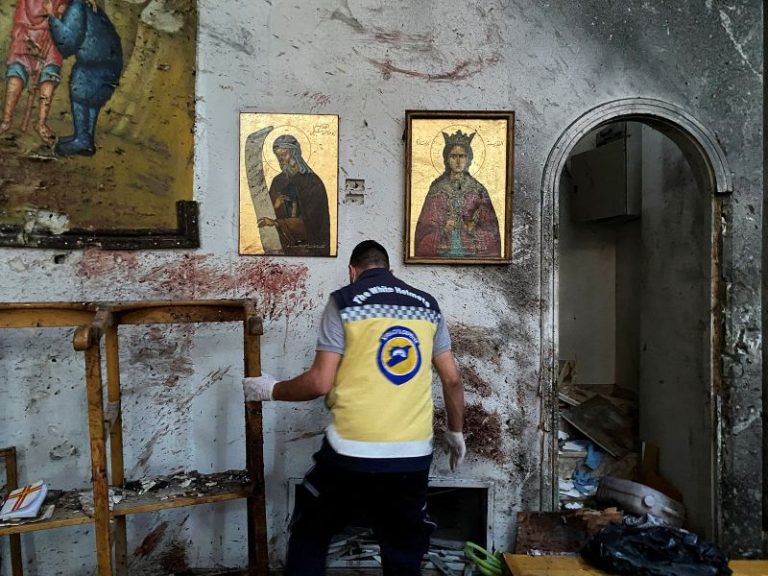
A video circulating on Syrian social media from inside the church shows dead bodies, significant destruction, shattered glass and broken chairs in the area where mass was being held, with blood visible throughout the scene.

Syria’s civil defense, popularly known as the White Helmets, said emergency teams were working to transfer the bodies to hospitals and secure the area.

“The treacherous hand of evil struck” on Sunday, the Greek Orthodox Patriarchate of Antioch said in a statement, writing that “an explosion occurred at the entrance of the church, resulting in the deaths of numerous martyrs and causing injuries to many others who were inside the church or in its immediate vicinity.”

“We offer our prayers for the repose of the souls of the martyrs, for the healing of the wounded, and for the consolation of our grieving faithful. We reaffirm our unwavering commitment to our faith and, through that steadfastness, our rejection of all fear and intimidation,” the church said.

The United Nations Special Envoy for Syria, Geir O. Pedersen, expressed “outrage” at the “heinous crime,” his office said in a statement.

“Mr. Pedersen calls on all to unite in rejecting terrorism, extremism, incitement and the targeting of any community in Syria. He sends his deepest condolences to the families of the victims and his hope for the recovery of those injured,” the statement said.

The United States’ Special Envoy for Syria, Thomas Barrack, called the attack an act of “cowardice,” saying in a statement that it has “no place in the new tapestry of integrated tolerance and inclusion that Syrians are weaving.”

The foreign ministries of Turkey, Jordan, Iraq, Israel, Greece, Cyprus, the United Arab Emirates, Qatar, Saudi Arabia, the Palestinian Authority, Yemen, Oman, Bahrain, Ukraine, Austria, Belgium, the Czech Republic and the Netherlands also spoke out in condemnation of the attack.

This post appeared first on cnn.com