Author

admin

Browsing

Adam Rozencwajg, managing partner at Goehring & Rozencwajg, shares his latest thoughts on the gold, silver and uranium markets, also discussing why he’s bullish on platinum.

In his view, it has ‘all the hallmarks of something we like to get involved with.’

More broadly, Rozencwajg sees commodities thriving amid a global monetary and trade regime shift.

Securities Disclosure: I, Charlotte McLeod, hold no direct investment interest in any company mentioned in this article.

This post appeared first on investingnews.com

triumph gold Corp. (TSXV: TIG) (OTC Pink: TIGCF) (FSE: 8N6) (‘triumph gold’ or the ‘Company’) is pleased to announce the acquisition of the Coyote Knoll Silver (Ag Gold (Au) Property, located in central Utah, approximately 40 km southwest of the prolific Tintic Mining District (Figure 1).

triumph gold has entered into an agreement to purchase the Coyote Knoll Silver-Gold property for the sum of $150,000USD and the issuance of one million common shares of the Company. Prior to one year from the date of purchase, one million common shares shall be issued to the seller; prior to two years from the date of purchase one million common shares will be issued; prior to three years from the date of purchase one million common shares shall be issued to the seller. Before four years from the date of purchase a three million dollar payment in cash or shares will be made to the seller.

Highlights:

  • Approximately 2,600 metres of RC drilling have been completed, highlighted by 1,350.36 g/t Ag and 3.86 g/t Au over 3.00 metres in ATC-C6 (Table 1 & 2 and Figure 2)NI 43-101 Disclosure 1.
  • Historical rock samples returned silver and gold values, up to 6,730.00 g/t Ag and 23.30 g/t Au (Table 2)NI 43-101 Disclosure 2.
  • Two east-west parallel veins were identified through reverse circulation (RC) drilling and exposed during mining.
  • Recent surface sampling confirmed silver and gold mineralization, with grab samples returning up to 795 g/t Ag and 1.58 g/t Au (Table 4)NI 43-101 Disclosure 2.
  • In 2012, a 12-ton representative bulk sample returned an average grade of 43.60 oz/ton silver and 0.13 oz/ton goldNI 43-101 Disclosure 3.
  • In 1998 Phoenix Gold Resources shipped Coyote Knoll ore to Clifton Mining’s mill at Gold Hill where a 1,000 ounces of silver doré was producedNI 43-101 Disclosure 4.
  • A second mineralized structure, trending northwest-southeast, has been identified through surface sampling and RC drilling.

John Anderson, Chairman and CEO of triumph gold, stated:

‘The Coyote Knoll acquisition represents an exciting addition to our portfolio. Located in a mining-friendly and historically significant region, the property demonstrates high-grade silver mineralization and favorable geological features, similar to those found in the Tintic Mining District. With the confirmation of epithermal silver-gold mineralization and the potential for further discovery, we look forward to advancing exploration at Coyote Knoll.’

Figure 1. Coyote Knoll property location map.

To view an enhanced version of this graphic, please visit:
https://images.newsfilecorp.com/files/5125/254408_c03b07c774e7e8a6_001full.jpg

Figure 2. Coyote Knoll drill and sample highlights.

To view an enhanced version of this graphic, please visit:
https://images.newsfilecorp.com/files/5125/254408_c03b07c774e7e8a6_002full.jpg

Location and Geological Overview:

Coyote Knoll is located in central Utah, approximately 85 km south of Bingham Canyon Cu-Mo-Au Porphyry deposit and 40 km southwest of the city of Eureka. Eureka is historically associated with the Tintic Mining District, which has been a major producer of gold, silver, lead, and zinc from both epithermal and Carbonate Replacement Deposits (CRD). The Tintic District is known for its productive mining history and the potential for undiscovered porphyry systems.

Coyote Knoll was discovered in 1988, with subsequent exploration activities including mapping, trenching, rock sampling, and induced polarization and magnetic geophysical surveys. Follow-up work also included near-surface Reverse Circulation RC-drilling, totaling 2,606.96 metres across 33 drill holes. Highlights from historical drilling are summarized in Table 1 & 2, and surface samples are highlighted in Table 3. A 12-ton representative bulk sample was also mined from a shallow open pit, centered over the east-west (70°) trending mineralized structure. Silver and gold epithermal mineralization was exposed over approximately 60 metres within the open pit and has been delineated for 1.5 km through surface trenching, sampling, and shallow RC drilling (Figure 2).

Table 1. Historic RC drilling composite highlights

Hole-ID From (m) To (m) Interval (m) Ag g/t Au g/t
AT1-C6 54.10 57.10 3.00 1350.36 3.86
CK-10 68.60 74.70 6.10 114.84 0.12
AT1-C5 49.80 54.30 4.50 99.37 0.40
CK-1 27.40 32.00 4.60 68.89 0.09
CK-10 51.80 54.90 3.10 67.81 0.38
CK-10 61.00 64.00 3.00 38.50 0.08
CK-2 36.60 39.60 3.00 60.00 0.18
CK-2 53.30 57.90 4.60 39.04 0.09
CK-15 21.30 24.40 3.10 40.39 0.07


NI 43-101 Disclosure 1.

*Composites grades were calculated using Datashed software with >25 g/t Ag cutoff and

Table 2. Historical drill attributes for Table 1 highlights.

Hole-ID Easting Northing Elevation (m) Depth (m) Azimuth Dip
AT1-C5 367,889 4,408,432 1,622 76 -90
AT1-C6 367,897 4,408,436 1,621 75 -90
CK-1 367,904 4,408,411 1,613 80 170 -60
CK-2 367,910 4,408,421 1,616 87 -90
CK-10 367,951 4,408,442 1,624 110 -90


NI 43-101 Disclosure 1.

Two additional historical drill holes (CK-141. and CK-232.) have previously been reported to contain high gold values and are in proximity to the open pit. CK-14 has an intercept of 8.19g/t Au and 1,060g/t Ag over 1.52 m from 9.14 m downhole. CK-23 has an intercept of 2g/t Au and 814g/t Ag over 1.52 m from 45.72 m downhole.

  1. Freeport-McMoRan Gold Company, 1989-1990; Reverse Circulation Drill Hole CK-14; from NI 43-101 Technical Report on the Coyote Mine Project Juab County, Utah, USA, Arthur J. Mendenhall.
  2. Freeport-McMoRan Gold Company, 1989-1990; Reverse Circulation Drill Hole CK-23; from NI 43-101 Technical Report on the Coyote Mine Project Juab County, Utah, USA, Arthur J. Mendenhall.

Table 3. Historic rock sample highlights

Sample-ID Easting Northing Ag g/t Au g/t
CK-5 367,870 4,408,430 6730.00 23.30
54359 367,924 4,408,270 6687.08 26.37
CK-6 367,870 4,408,430 6490.00 13.10
CKRX-0001 367,928 4,408,377 5570.00 12.25
CK-3 367,870 4,408,430 2270.00 9.63
48396 367,884 4,408,389 1673.83 7.30
48395 367,933 4,408,423 1638.86 0.51
48382 367,927 4,408,360 1086.86 6.03
CK-4 367,870 4,408,430 979.00 14.05
48380 367,911 4,408,333 600.69 1.03
54354 367,858 4,408,379 370.97 0.31
56251 367,411 4,408,309 172.00 173.14
CKRX-0027 368,645 4,408,585 3.38 0.02


NI 43-101 Disclosure 2.

While Coyote Knoll is approximately 40 km southwest of the Tintic District the geological setting at Coyote Knoll exhibits similarities to the Tintic Mining District. Where precious metal epithermal veins at the Trixie Mine are formed within faulted quartzites and the Burgin and Tintic Standard mines are hosted in carbonate-rich stratigraphy forming CRD. During the March site visit, the Company also toured the high-grade Trixie Gold Mine to gain further insight into the regional geological setting of the Tintic Mining District. At Coyote Knoll, epithermal mineralization is located along the margin a large volcanic caldera hosting a granitic center. Veining crosscuts quartzite, carbonate-rich stratigraphy and volcanic flows. This provides an encouraging framework for the exploration of both epithermal veins and potential carbonate replacement mineralization at Coyote Knoll.

Fieldwork conducted during a March 2025 site visit confirmed the presence of epithermal-style mineralization with key geological features including:

  • Silica-flooded pebble clastic fault breccia (pebble dyke), jasperoid, and chalcedony vein infill hosted within faulted quartzite.
  • Mineralization consisted of native silver and silver sulphide ‘sulfosalt’ minerals.
  • Secondary northwest-trending epithermal veining represented by quartz-carbonate and jasperoid infill. This trend contains anomalous silver and elevated pathfinder elements such as arsenic (As), copper (Cu), lead (Pb), antimony (Sb), and zinc (Zn) (Table 4).

Table 4. Coyote Knoll grab sample results (March 2025 site visit)

Sample-ID Easting Northing Ag
g/t
Au
g/t
As
ppm
Cu
ppm
Pb
ppm
Sb
ppm
Zn
ppm
A001051 367,537 4,408,331 1.23 25.40 8.90 11.80 0.85 4.00
A001052 367,905 4,408,383 0.22 364.00 9.60 4.50 2.27 47.00
A001053 367,874 4,408,395 0.31 207.00 21.50 11.50 2.61 147.00
A001054 367,839 4,408,395 795.00 1.58 61.40 68.40 177.50 67.60 24.00
A001055 367,787 4,408,386 20.70 0.06 431.00 45.30 31.70 7.98 122.00
A001056 368,438 4,408,853 1.23 29.70 6.60 9.60 2.85 8.00
A001057 368,424 4,408,894 0.25 11.40 19.40 1.80 0.31 12.00
A001061 367,891 4,408,372 1.86 381.00 82.80 38.70 19.65 36.00
A001062 367,898 4,408,367 1.87 66.30 27.40 22.40 1.00 7.00


NI 43-101 Disclosure 2.

National Instrument 43-101 Disclosure

The technical content of this news release has been reviewed and approved by triumph gold’s Principal Geologist Marty Henning, P.Geo., a ‘Qualified Person’ as defined in National Instrument 43-101 – Standards of Disclosure for Mineral Projects of the Canadian Securities Administrators (‘NI 43-101’). He verified the data collected during the March 2025 site visit, including sampling, analytical and test data, and the underlying technical information in this news release.

The historical data presented in this release has not been verified for accuracy and reliability with the use of current quality assurance, quality control, or chain of custody standards current with NI 43-101 best practices. See the following disclaimers for additional details.

  1. The Company has not done sufficient work to classify the historical drilling information as current to NI 43-101 and is not treating the historical drilling disclosure as a current mineral estimate. Historical drilling database has not been verified for accuracy or quality. The reported historical values in this release require verification through additional exploration drilling, twinned holes will be used to verify style, grade and widths of mineralization.
  2. Grab samples are from select surface material and may not represent true underlying mineralization and drilling is required to confirm mineralization width and grade continuity below surface. Additional sampling is required to verify historical rock sample database.
  3. The 12-ton bulk sample reported in 2012 has not been verified for accuracy or quality control and therefore the reported tonnage and grades are not considered a 43-101 mineral resource estimate or a pre-feasibility study. Additional exploration drilling and metallurgical studies are required to verify tonnage and concentrations of silver and gold contained beneath the mined-out area. The bulk sample values are provided to illustrate the presence of surface mineralization.
  4. The 1,000 ounces of silver doré, produced in 1998 reported by Phoenix Gold Resources has not been verified. This information is not considered a mineral resource estimate as there were no reported head grades or tonnage provided. Additional drilling and metallurgical studies are required to verify width, strike and plunge of the surface mineralization reported from the open pit operation at Coyote Knoll. This bulk sample information is provided to illustrate the presence of surface mineralization.

Rock samples collected during the site were located using a handheld GPS, material was sealed in heavy poly ore sample bags with a representative sample retained for future inspection. Samples were placed into a 5-gal pail and shipped to ALS Vancouver for analyses. Samples were crushed, split and pulverized using PREP-31 specifications and analyses was completed using ME-GRA22 for Ag and Au as well as ME-MS41 for a multielement output utilizing an aqua regia digest, over limit elements (Ag, Cu and Pb) were analyzed using OG46.

About triumph gold Corp.

triumph gold is a Canadian based, growth-oriented exploration and development company with a district scale land package in mining friendly Yukon. Led by an experienced management and technical team, The Company is focused on actively advancing their flagship Freegold Mountain Project using multidiscipline exploration and evaluation techniques. The Company acknowledges the Freegold Mountain, Tad Toro and Big Creek properties are situated within the traditional territory of the Little Salmon Carmack and Selkirk Nations. triumph gold is committed to ongoing engagement with local communities through communication, environmental stewardship, and local employment.

The road-accessible Freegold Mountain Project, located in the Dawson Range Au-Cu Belt, is host to three NI 43-101 Mineral Deposits (Nucleus, Revenue, and Tinta Hill). The Project is 200 square kilometers and covers an extensive section of the Big Creek Fault Zone, a structure directly related to epithermal gold and silver mineralization as well as gold-rich porphyry copper mineralization.

The Company owns 100% of the Big Creek and Tad/Toro gold-silver-copper properties situated along strike of the Freegold Mountain Project within the Dawson Range.

The Company also owns 100% of the Andalusite Peak copper-gold property, situated 36 km southeast of Dease Lake within the Stikine Range in British Columbia. The Company acknowledges the Andalusite Peak property project is situated within the traditional territory of the Tahltan Nation. triumph gold is committed to ongoing engagement with local communities through communication, environmental stewardship, and local employment.

On behalf of the Board of Directors,

Signed ‘John Anderson’

John Anderson, Executive Chairman

For further information about triumph gold, please contact:

John Anderson, Executive Chairman
triumph gold Corp.
(604) 218-7400
janderson@triumphgoldcorp.com

Neither the TSX Venture Exchange nor its Regulation Services Provider (as that term is defined in policies of the TSX Venture Exchange) accepts responsibility for the adequacy or accuracy of this release.

This news release contains forward-looking information, which involves known and unknown risks, uncertainties and other factors that may cause actual events to differ materially from current expectation. Important factors – including the availability of funds, the results of financing efforts, the completion of due diligence and the results of exploration activities – that could cause actual results to differ materially from the Company’s expectations are disclosed in the Company’s documents filed from time to time on SEDAR+ (see www.sedarplus.ca). Readers are cautioned not to place undue reliance on these forward-looking statements, which speak only as of the date of this press release. The company disclaims any intention or obligation, except to the extent required by law, to update or revise any forward-looking statements, whether as a result of new information, future events or otherwise

To view the source version of this press release, please visit https://www.newsfilecorp.com/release/254408

News Provided by Newsfile via QuoteMedia

This post appeared first on investingnews.com

In this video, Mary Ellen highlights key areas of the stock market that gained strength last week, including Staples and Aerospace stocks. She also shares several Dividend Aristocrat stocks that can help stabilize your portfolio in times of market volatility. Whether you’re seeking defensive plays or looking to align with sector rotation trends, this video provides practical insights to strengthen your trading strategy.

This video originally premiered May 30, 2025. You can watch it on our dedicated page for Mary Ellen’s videos.

New videos from Mary Ellen premiere weekly on Fridays. You can view all previously recorded episodes at this link.

If you’re looking for stocks to invest in, be sure to check out the MEM Edge Report! This report gives you detailed information on the top sectors, industries and stocks so you can make informed investment decisions.

Earnings season may be winding down, but a few standout names could still make headlines this week. If you’re looking for potential moves, keep an eye on these three stocks — Dollar Tree, Inc. (DLTR), CrowdStrike Holdings, Inc. (CRWD), and Broadcom, Inc. (AVGO).

Each of these names is at a pretty interesting inflection point right now. It might be worth waiting to see how things play out before making any big bets.

Dollar Tree (DLTR): Quiet Comeback with Room to Run?

Dollar Tree (DLTR) broke out of a long-term downtrend and, as of the last quarter, is back above key moving averages. Many of the beaten-down discount chains, such as Five Below (FIVE) and Dollar General (DG), have started to reverse major downtrends. This week, we will see if earnings momentum can keep going, as DLTR stock has rallied 21% year-to-date.

Investors will be looking for insight into how DLTR is navigating the transition after the $1 billion Family Dollar sale (yes, they paid $8.5 billion in 2015) and how its core stores are performing in the current economic environment. The last two quarters have been relatively calm, as DLTR stabilized with minor gains of 3.1% and 1.9%. That stability comes after a three-quarter losing streak, with average losses of -13.7%.

From a technical standpoint, DLTR made its big move in mid-April as it broke out of a longer-term neutral range and a long-term downtrend. The stock price has eclipsed the 50- and 200-day moving averages and seems to be back on the right track.

The breakout of the rectangular bottom gives an upside target of roughly $98 a share, so there is room for DLTR to run. That move would fill the gap created last September and bring shares into a stronger resistance area around $100. On the downside, there may be an opportunity to enter DLTR, as we have a potential scenario where old resistance becomes support, giving an entry level around $79.50/$80. That would be a good risk/reward set-up for those who may have missed the initial breakout.

Overall, the stock still has room to run, but most of this upside move may already be in the stock, as the price approached an overbought condition with much overhead resistance ahead.

CrowdStrike (CRWD): Heating Up Before Earnings

CrowdStrike (CRWD) has returned from the ashes after last year’s Delta Air Lines, Inc. (DAL) computer outage that caused over 7000 cancelled flights. As it heads into this week’s earnings, shares are trading just under all-time highs.

The cybersecurity company has seen shares decline over the past two results, but that hasn’t stopped its continued momentum. The stock averages a one-day move of +/- 8.5%, so expect volatility.

Technically, CRWD comes into the week at an intriguing pivot point. After breaking out to new highs, the stock pulled back to its old resistance areas from which it broke above.  Will old resistance become support, or are we looking at a potential bull trap?

The relative strength index (RSI) indicates there may be room to run. We have seen some extreme overbought conditions in the past, and we are not there yet. A solid beat and guide could see additional momentum in what continues to be one of the top stocks within the cybersecurity sector.

Speaking of strength, CRWD is shining on a relative basis. It’s up 36.7% year-to-date, outperforming CIBR, the biggest cybersecurity ETF in CIBR, which is up 12.8%. That said, downside risk could be steep given the recent run. Stepping in front of this stock ahead of results could be costly. On weakness, wait for a better risk/reward entry and look for support just around $405.

Broadcom (AVGO): Ready to Step Out of Nvidia’s Shadow?

Broadcom (AVGO) is Nvidia’s baby brother. It is in the $1 trillion market cap club, a top holding in both the Semiconductor ETF (SMH), the Technology ETF (XLK), and the Nasdaq 100 (QQQ).

AVGO has grown mightily in NVDA’s shadow for years now. Shares have rallied just over 500% from their 2022 lows, which pales to the 1250+% rally in Nvidia. However, over the past 52 weeks, AVGO shares have risen 82% compared to Nvidia’s 23% gain.

Now that we’ve seen how price action settled out with NVDA, what could this mean for AVGO?

Technically, if AVGO wanted to step out of NVDA’s shadows, this would be the chance to do so and lead the semiconductors higher. However, momentum is waning, and we continue to see large caps struggle to make new highs.

The table is set for a potentially large breakout. AVGO is at a key resistance area just under $250. It couldn’t break through it last week, but could earnings be the catalyst for getting it over the top? Given the overbought conditions and tough market environment, it should be a challenge. You may be able to buy this stock on a dip and wait for the rest of the market to catch up as we look for more clarity on tariff policy. Look for a pullback to the $220 area to add to or enter the name.

Long-term investors should ignore the noise to come. AVGO has suffered through the worst and should break out in due time. It just may not be this time.

Staples and Tech Swap Positions Again

The weekly sector rotation continues to paint a picture of a market in flux, with defensive sectors gaining ground while cyclicals take a step back. This week’s shifts underscore the ongoing volatility and lack of clear directional trade that’s been characteristic of recent market behavior.

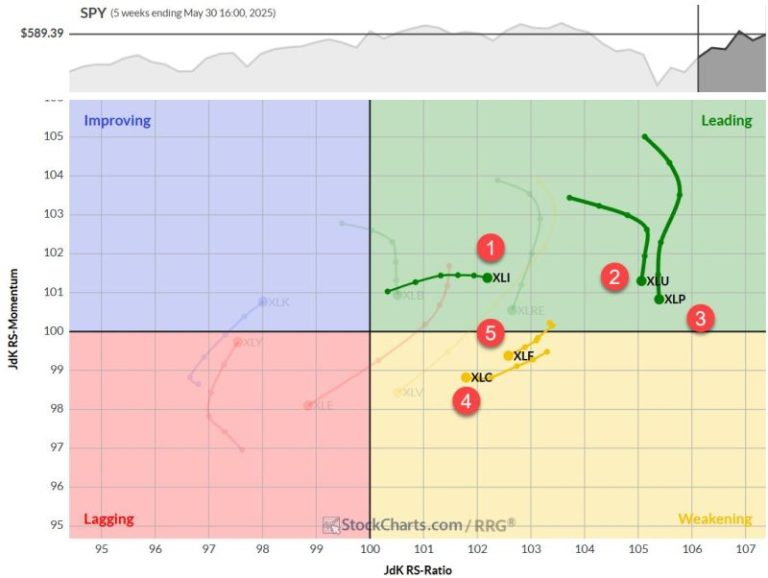
The sudden jump in relative strength for defensive sectors last week has pushed Consumer Staples back into the top 5, at the cost of Technology.

  1. (1) Industrials – (XLI)
  2. (3) Utilities – (XLU)*
  3. (6) Consumer Staples – (XLP)*
  4. (2) Communication Services – (XLC)*
  5. (4) Financials – (XLF)*
  6. (5) Technology – (XLK)*
  7. (8) Real-Estate – (XLRE)*
  8. (9) Materials – (XLB)*
  9. (7) Consumer Discretionary – (XLY)*
  10. (11) Healthcare – (XLV)*
  11. (10) Energy – (XLE)*

Weekly RRG

Looking at the weekly Relative Rotation Graph (RRG), we’re seeing some interesting movements. Industrials continues its upward trajectory on the RS-Ratio scale, solidifying its top position. Meanwhile, Utilities and Consumer Staples — our #2 and #3 sectors, respectively — are maintaining high RS-Ratio levels despite a momentum setback.

Communication services and financials, rounding out the top 5, find themselves in the weakening quadrant. However, they’re still comfortably above the 100 level on the RS-Ratio scale. This positioning gives them a good shot at curling back into the leading quadrant before potentially hitting lagging territory.

Daily RRG

Switching to the daily RRG, we can see some significant moves over the past week.

Consumer Staples have made a considerable leap, landing deep in the improving quadrant with the highest RS-Momentum reading. This surge explains its return to the top 5. Utilities isn’t far behind, also making a strong move into the improving quadrant. Financials, while in the lagging quadrant, are showing less dramatic movement compared to staples and utilities. Its shorter tail on the RRG indicates a less powerful move, but its high position on the weekly RRG is keeping it in the top 5 — for now.

Industrials: Strength Confirmed

The #1 sector is pushing against overhead resistance around 143 for the third consecutive week. A break above this level could trigger an acceleration higher. The relative strength chart vs. the S&P 500 has already broken out, continuing to pull the RRG lines upward.

Utilities: Bouncing Back

After a weak showing two weeks ago, utilities closed last week at the top of its range. There’s still resistance lurking just below 85 (around 84), but a break above could spark a rally. The raw RS line is grappling with the upper boundary of its sideways trading range, causing the RRG lines to roll over while remaining in the leading quadrant.

Consumer Staples: Testing Resistance

Staples has rebounded to the upper boundary of its trading range, with key resistance between 82 and 83.50. A spike to $83.90 represents the recent high-water mark. Breaking above this barrier could accelerate the move higher.

The raw RS line has peaked against overhead resistance and needs to form a new low to support the RRG lines.

Communication Services: Holding Steady

XLC is trading around $101.40, with overhead resistance a few dollars away, near $ 105. The raw RS line remains within its rising channel, but we’ll need to see improved relative strength soon to maintain this positive trend. The sector sits in the weakening quadrant, but has the potential to push back into leading territory with a strong relative strength (RS) rally.

Financials: At a Crossroads

The financial sector is struggling with old resistance that’s now acting as support. Its RS line is testing the lower boundary of its rising channel. Financials needs a couple of strong weeks in both price and relative strength to maintain its top 5 position.

Portfolio Performance

As of last Friday’s close, our model portfolio is lagging the S&P 500 by just over 5%. This performance gap has widened slightly from last week, but remains in line with the volatile sector rotations we’ve been seeing.

The current market environment presents an apparent dilemma for sector rotation strategies. While defensive sectors are gaining prominence, cyclicals are taking a back seat — at least for now. This flip-flop situation is common in volatile markets seeking direction, but it’s causing more frequent trades in our model than we’d typically expect.

For meaningful trends to emerge, the market needs to stabilize and establish a clear directional bias. Until then, we’re likely to see continued back-and-forth movement as investors grapple with mixed economic signals and shifting sentiment.

#StayAlert and have a great week. –Julius


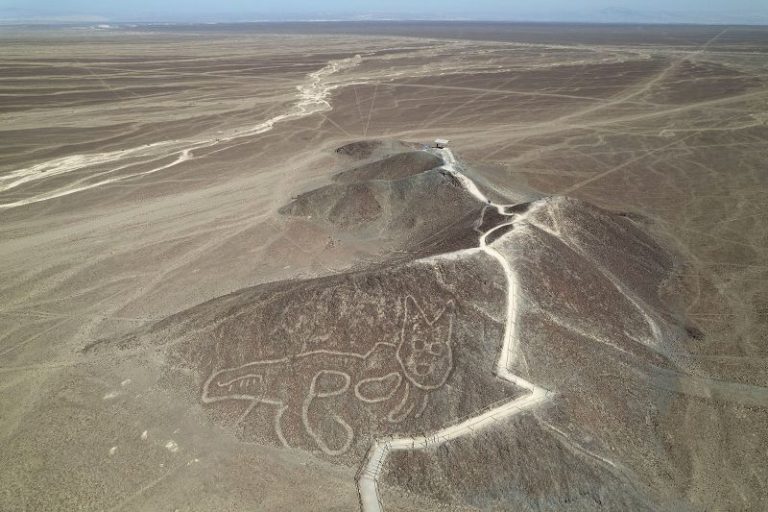
Peru’s decision to shrink its archeological park home to the famous Nazca Lines by around 42% — an area roughly the size of 1,400 soccer fields — has sparked alarm among conservationists, archaeologists and environmental advocates.

Critics say the rollback paves the way for informal mining and weakens decades of cultural and ecological protection, while the government says the adjustment reflects updated scientific studies and does not compromise the UNESCO World Heritage status or the site’s core protections.

“The reduction not only removes protections — it does so precisely where extractive activity is expanding,” said Mariano Castro, Peru’s former vice minister of the environment, adding that the decision could cause “very serious risks and cumulative damage,” as it excludes zones with active or pending mining claims.

Castro added that safeguards for archaeological heritage during the formalization of artisanal mining are already limited.

“This is made worse by the ministry of culture’s failure to consider the cumulative impact of dozens or even hundreds of mining operations on sensitive archaeological zones,” he said.

The area in question forms part of a UNESCO-recognized World Heritage Site, home to the Nazca Lines — massive geoglyphs etched into the desert thousands of years ago — and one of Peru’s most fragile desert ecosystems.

UNESCO told The Associated Press it hasn’t been notified by Peruvian authorities of any changes to the boundaries of the World Heritage site, which are crucial for its protection. The organization will request more information from the authorities.

Peruvian environmental lawyer César Ipenza, who has closely followed the decision, said the resolution has already been approved and that it reduces the Nazca zone by more than 1,000 hectares.

“This is a weakening of both environmental and cultural protections,” Ipenza said. “The state should be upholding its commitments under international agreements, not yielding to private interests.”

Ipenza and others say the rollback reflects a pattern of regulatory concessions to mostly informal gold miners.

“There’s an alliance between the current government and informal mining sectors,” he said. “The legal framework continues to be relaxed to benefit them.”

Peru’s ministry of culture, which decided on May 30 to reduce the Nazca reserve from about 5,600 square kilometers to roughly 3,200 square kilometers, declined to answer specific questions from the AP. Instead, it sent a press release saying the adjustment was based on updated archaeological studies and does not affect the UNESCO World Heritage designation or its buffer zone.

The ministry said it remains committed to preserving the site’s cultural heritage through regulated management.

A day after the May 30 decision, Peru’s Minister of Culture Fabricio Valencia acknowledged that illegal mining exists within the reserve.

“Unfortunately, informal mining is an activity present in this area, but the measure we have taken does not mean it will be encouraged, nor that the likelihood of any harm from informal mining will increase. That will not happen,” Valencia said on RPP, one of Peru’s largest radio programs.

When asked for more details about the presence of illegal activity in the reserve, Valencia said, “there are some mining deposits, but I don’t have exact information on what type of mineral is there.”

Castro, the former vice minister, warned the move could violate Peru’s own laws.

“It contravenes Article 5(h) of the Environmental Impact Assessment Law, which mandates the protection of archaeological and historical heritage,” he said.

Ipenza said the government is enabling illegality under the guise of technical adjustments.

“It is shameful to forget our ancestors and our heritage, and to disguise decisions that pave the way for sectors seeking to impose illegality, such as illegal and informal mining,” he said. “This decision benefits those groups and harms all Peruvians.”

This post appeared first on cnn.com

Around 13% of Mexicans likely turned out to vote in the country’s first-ever judicial election, Mexico’s INE electoral authority said on Monday, as the government hailed a successful process while analysts said the low turnout could undermine an already controversial reform.

President Claudia Sheinbaum estimated that some 13 million of around 100 million eligible voters cast ballots on Sunday to elect some 2,600 judges and magistrates, including all nine Supreme Court justices.

Counting is set to conclude on June 15, but INE officials estimated the turnout at between 12.57% and 13.32% using a calculation based on several samples taken across the country.

Sheinbaum called the process a “complete success,” citing a free vote and a frugal campaign at a morning press conference.

“Everything can be perfected. We will draw conclusions from yesterday to make improvements for 2027,” she said, pointing to another vote in two years that is scheduled to fill over 1,000 more judicial positions.

Interior Minister Rosa Icela Rodriguez said that “the voting took place in a climate of peace and tranquility across the length and breadth of the country.”

“Yesterday’s turnout at the polls met expectations,” she said. “It was an innovative process that generated interest among the participants.”

Voting in Mexico is not mandatory and there is no minimum turnout required to legitimize an election. Pollsters had warned of poor turnout over boycott calls by the opposition and the complexity of voting for a large number of candidates.

Questionable credentials

Goldman Sachs’ chief Latin America economist, Alberto Ramos, said in a note that the low turnout took away from the process’ legitimacy, and that the pre-selection process and logistical organization were “fraught with controversy.”

“The vast majority of the roughly 3,400 candidates were largely unknown, many have limited legal experience and some questionable credentials for the seats they are seeking,” he said.

Bradesco analyst Rodolfo Ramos said he thought the turnout was surprisingly low, “considering Sheinbaum’s high approval rating and the fact that the majority of Mexicans were in favor of directly voting for judges.”

Sheinbaum, who inherited the judicial election project from her predecessor and mentor, former President Andres Manuel Lopez Obrador, has backed the vote as a way to democratize justice and root out corruption and nepotism.

However, critics say it could remove checks and balances on the executive power and allow for organized crime groups to wield greater influence by running their own candidates.

The run-up to the vote had been dominated by a scandal over some of the candidates, including a convicted drug smuggler and a former lawyer of drug kingpin Joaquin “El Chapo” Guzman.

Late on Sunday, Mexico’s Specialized Prosecutor’s Office for Electoral Crimes said it had received 23 reports of possible electoral crimes related to the elections of nearly 900 positions at the federal-level judiciary.

This post appeared first on cnn.com

So, Russia and Ukraine are still as far apart as ever, with the two warring countries unable to make a significant breakthrough in direct talks in Istanbul.

While there was agreement to exchange more prisoners, Moscow and Kyiv remain deeply divided over how to bring the costly and bitter Ukraine war to an end.

Russia has shown itself to be particularly uncompromising, handing Ukrainian negotiators a memorandum re-stating its maximalist, hardline terms which would essentially amount to a Ukrainian surrender.

Expectations were always low for a Kremlin compromise. But Moscow appears to have eliminated any hint of a readiness to soften its demands.

The Russian memorandum again calls on Ukraine to withdraw from four partially occupied regions that Russia has annexed but not captured: a territorial concession that Kyiv has repeatedly rejected.

It says Ukraine must accept strict limits on its armed forces, never join a military alliance, host foreign troops or aquire nuclear weapons. It would be Ukrainian demilitarization in its most hardline form, unpalatable to Ukraine and much of Europe, which sees the country as a barrier against further Russian expansion.

Other Russian demands include the restoration of full diplomatic and economic ties, specifically that no reparations will be demanded by either side and that all Western sanctions on Russia be lifted.

It is a Kremlin wish-list that, while familiar, speaks volumes about how Moscow continues to imagine the future of Ukraine as a subjugated state in the thrall of Russia, with no significant military of its own nor real independence.

This uncompromising position comes despite two important factors which may have given the Kremlin pause.

Firstly, Ukraine has developed the technical capability to strike deep inside Russia, despite its staggering disparity of territory and resources. The stunning drone strikes recently targeting Russian strategic bombers at bases thousands of miles from Ukraine is a powerful illustration of that. Ukraine, it seems, has some cards after all, and is using them effectively.

Secondly – and arguably more dangerously for Moscow – the Kremlin’s latest hardline demands come despite US President Donald Trump’s increasing frustrations with his own Ukraine peace efforts.

Trump has already expressed annoyance with his Russian counterpart, Vladimir Putin, who he said had gone “absolutely MAD” after massive Russian strikes on Ukraine last week.

But now, Trump himself is under pressure as a cornerstone of his second term foreign policy – bringing a rapid end the Ukraine war – looks decidedly shaky.

There are powerful levers to pull if Trump chooses, like increasing US military aid or imposing tough new sanctions, such as those overwhelmingly supported in the US Senate. One of the key backers of a cross-party senate bill that aims to impose “crippling” new measures on Moscow, Senator Richard Blumenthal, accused Russia of “mocking peace efforts” at the Istanbul talks and in a carefully worded post on X accused the Kremlin of “playing Trump and America for fools.”

It is unclear at the moment how the mercurial US president will react, or what – if anything – he will do.

But the outcome of the Ukraine war, specifically the brokering of peace deal to end it, has become inextricably linked with the current administration in the White House.

The fact that Putin has once again dug in his heels and presented an uncompromising response to calls for peace, may now force Trump to act.

This post appeared first on cnn.com

Palestinians on their way to receive aid from a distribution site in southern Gaza have come under fire for a third consecutive day, with nearly 30 people killed and dozens wounded, according to the Palestinian Ministry of Health and Nasser hospital.

The ministry said Israeli forces opened fire on Palestinians as they made their way to the distribution site in Tel al-Sultan in Rafah early Tuesday.

The Israeli military said its forces opened fire multiple times after identifying “several suspects moving toward them, deviating from the designated access routes.”

“The troops carried out warning fire, and after the suspects failed to retreat, additional shots were directed near a few individual suspects who advanced toward the troops,” the Israel Defense Forces (IDF) said in a statement, which also said they are looking into reports of casualties.

At least 27 people were killed and dozens injured, according to the Palestinian health ministry and the director of Nasser hospital in Gaza.

The firing occurred west of Rafah in the area surrounding the Al-Alam roundabout, according to paramedics from the Palestine Red Crescent Society, near the same location as shooting incidents the last two days.

Early Tuesday morning, a Facebook page which the controversial US- and Israel-backed Gaza Humanitarian Foundation (GHF) has used to publicize information about the opening of distribution sites said one location would be open in southern Gaza and warned residents to adhere to a designated corridor starting at 5 a.m.

“The IDF will be in the area to secure the safe passage,” the statement said.

The incident marks the third day in a row that people have been killed on their way to the GHF distribution point west of Rafah while attempting to secure food as famine conditions worsen in Gaza following an 11-week blockade by Israel.

Three Palestinians were shot dead and dozens wounded as they were on their way to access aid from the site on Monday morning, Palestinian and hospital authorities said. The Israel Defense Forces (IDF) said that Israeli forces fired warning shots approximately a kilometer from the aid distribution site and that it was looking into the details of the incident.

On Sunday, dozens of Palestinians were shot dead by the Israeli military in the same area, according to Palestinian officials and eyewitnesses. Israel’s military denied that its troops fired “within or near” the aid distribution site.

Palestinian officials said 31 people had been killed and scores wounded in Sunday’s incident. An Israeli military source acknowledged that Israeli forces fired toward individuals about one kilometer (1093 yards) away before the aid site opened.

This is a developing story and will be updated.

This post appeared first on cnn.com