
Author

admin

Browsing

For months, investors have been on edge over U.S.-China tariff tensions, bracing for everything from fears of empty shelves to rising prices. But after this weekend’s trade talks, where both sides agreed to temporary tariff cuts (emphasis on temporary), stocks surged.

On Monday, the Dow Jones Industrial Average ($INDU) jumped 1,160 points, while the S&P 500 ($SPX) and Nasdaq Composite ($COMPQ) rallied 3.26% and 4.35%, respectively.

Monday’s rally sparked hopes that the worst may be over. Yet analysts remain split: some see signs of a bottom, while others warn this 90-day pause is just the start of a long, messy negotiation.

So here’s the critical question: If this is the bottom, which sector (or industry) leads the rebound, and is it worth investing in it right now? For investors, the answer could be the difference between riding the next bull wave or watching it pass by.

Nasdaq-100 Shows Strength, but Which Sector Leads?

Checking StockCharts’ Market Summary midday on Monday, the Breadth panel showed that the tech-heavy Nasdaq 100 ($NDX) had the most percentage of stocks (62%) trading above their 200-day simple moving average (SMA), indicating early strength and recovery (displayed in the Moving Averages tab).

FIGURE 1. MARKET SUMMARY – INDICES TRADING ABOVE 20 TO 200-DAY MOVING AVERAGES. The Nasdaq 100 is the most bullish index above the 200-day, warranting a closer examination.

About 51% of the Nasdaq 100 is made up of Information Technology stocks, while Consumer Discretionary and Communication Services together account for roughly 31% of the index.

Information Technology Dominates the Index

To get a clearer sense of market breadth, it’s useful to examine the sector-level Bullish Percent Index (BPI), which shows the percentage of stocks within each sector exhibiting technical strength.

FIGURE 2. MARKET SUMMARY SECTOR BULLISH PERCENT INDEX. While many sectors have bullish BPIs, the tech sector is leading.

While Communications and Discretionary are exhibiting technical strength, the Information Technology sector is leading the pack, with over 91% of stocks triggering Point & Figure buy signals.

Semiconductors: The Bellwether to Watch

While tech is also comprised of various industries, only one—semiconductors—is widely regarded as a “bellwether” industry. Shifting over to the US Industries panel, semiconductors displayed the highest StockCharts Technical Rank (SCTR).

FIGURE 3. BELLWETHER INDUSTRY SCTR SCORES. Among the bellwether industries listed, chipmakers are outpacing everything else.

While my threshold for bullish SCTR reading is 76, the semiconductor industry is the only bellwether industry that clears that bar.

But what might the performance of the Nasdaq 100, semiconductor, and broader market performance look like side by side? To answer this question, I plotted all three on a one-year PerfCharts view.

 FIGURE 4. PERFCHARTS OF SEMICONDUCTORS, NASDAQ 100, AND THE S&P 500. Here, semiconductors aren’t looking so hot, being the laggard of the bunch.

Using VanEck Vectors Semiconductor ETF (SMH) as the industry proxy, you can see that SMH was leading the Nasdaq 100 and S&P 500 last summer, but began lagging the two indexes starting in November. SMH was the hardest hit in the aftermath of the Trump tariffs, and, while it’s recovering, its performance is still trailing both indices.

This raises two key questions: First, is SMH’s upswing a true recovery or a temporary bounce? And second, is it worth investing in SMH in this stage of the cycle (in other words, does it present an opportunity to catch an uptrend early on)?

Weekly Chart Signals: Bear Market Drop or Recovery?

Let’s take a closer look at SMH, starting with a weekly chart.

FIGURE 5. WEEKLY CHART OF SMH. From a primary trend perspective, one that can last years, the uptrend is arguably intact, though facing challenges.

Here are the key points to look at:

  • SMH is trading above the 40-week SMA (equivalent to a 200-day SMA) following a sharp price gap up. But can it hold above that level?
  • SMH plunged 39.8% from its 2024 high of around $280 to the 2025 low of $170. This is a textbook bear market drop that raises the question: Is this latest surge just a bear market rally?
  • On the other hand, a long-term Fibonacci Retracement measured from the 2022 low to the 2024 high found support at the 50% and 61.8% retracement levels. This kind of pullback is not only “normal”, but also supports the view that SMH’s bullish “primary trend” is still intact.
  • However, the Chaikin Money Flow (CMF) is signaling weak buying pressure. For the rally to continue, there needs to be stronger accumulation, something the CMF has yet to confirm.

Daily Chart View: Support, Resistance, and Warning Signs

After looking at SMH from a broader scale, what might the price action reveal if we were to zoom in using a daily chart?

FIGURE 6. DAILY CHART OF SMH. Zooming in, SMH’s situation looks even less bullish.

This chart tells a tougher story: SMH looks ready to re-enter the months-long trading range it broke to the downside in March.

Should You Invest In SMH? Here’s What to Watch

To answer this question, here’s some points you might want to focus on:

For one, note how closely the stochastic oscillator cycles mirror SMH’s fluctuations. With a reading above 96, SMH may be due for a near-term pullback.

Should it pull back, SMH will need to remain above or bounce at the $210 support range (highlighted in blue) for the current, albeit small, uptrend to remain intact. Below that, it might bounce at the consecutive swing lows—$185 and $170—but such a deep pullback indicates weakness and raises the possibility that SMH may slip back into the trading range (highlighted in yellow) that dominated a lengthy five-month period.

On the upside, SMH needs to eventually clear that same range before challenging its all-time highs at the $281 level. If SMH manages to do so, it’s likely to unfold in a series of higher highs and higher lows, which will take some time to develop.

At the Close: A Bullish Setup or Bull Trap?

While SMH has begun to exhibit significant technical strength, warning signs remain. If you’re bullish on semiconductors, the next few weeks will be critical. Holding the $210 support zone is key for keeping the uptrend intact. A drop toward $185 or $170 would raise serious doubts about the sustainability of the current rally.

If SMH can clear its trading range and build a structure of higher highs and higher lows, it could be poised to challenge its all-time highs once again. Until then, stay cautious and keep a close eye on the technical levels discussed above.


Disclaimer: This blog is for educational purposes only and should not be construed as financial advice. The ideas and strategies should never be used without first assessing your personal and financial situation, or without consulting a financial professional.
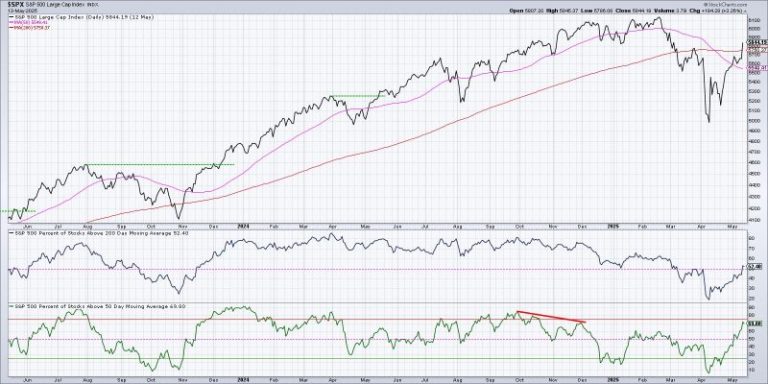

We’ve been cautious about the uptrend phase off the April low for a number of reasons, including the lack of breadth support.  While short-term measures of breadth had turned more positive, the long-term breadth conditions had remained firmly in the bearish realm.  With the renewed strength in risk assets over the last week, our long-term breadth measures now indicate a healthy uptrend phase.  

Today we’ll dive a little deeper into one of those breadth indicators, talk about why we track moving average breadth, and show how this recent bullish signal could be a sign of stronger price action to come.

Here we’re showing the S&P 500 on a closing basis along with its 50-day and 200-day moving averages.  Below that, we’re tracking the percent of S&P 500 stocks above their 200-day moving average, followed by the percent of stocks above their 50-day moving average.

Starting at the bottom, we can see that less than 10% of S&P 500 members were above their 50-day moving average at the April 2025 low.  The last time we had reached below the 10% level was back in October 2023, just before a significant market bottom.

While the surge in this short-term breadth indicator over the last month has suggested a tactical rally, the panel above shows how there were still less than 50% of S&P 500 members above their 200-day moving average.  So most stocks had regained the short-term moving average, but were still languishing below the long-term moving average.

As risk assets have surged higher this week, it’s meant enough upside momentum that now most S&P 500 members are back above their 200-day moving average.  Now let’s look at a longer-term time frame and consider previous instances where this long-term moving average breadth indicator has gone from below 25% to above 50%.

We’ve identified eight occurrences of this pattern since the 2009 market low.  In all eight occurrences, the S&P 500 has experienced positive returns in the next 12 months.  And with the exception of the signal in October 2015, we haven’t seen any retest of the previous swing low.

Let’s dig into that 2015 example a little further, and you’ll see what differentiated that particular signal from all the others.

In all the other occurrences, the S&P 500 broke above its 200-day moving average and held that crucial level of support.  In Q4 2015, however, the S&P 500 failed to hold the 200-day moving average, and the breadth indicators soon rotated back to a bearish phase.

It took another attempt in March 2016 before the chart finally resolved to the upside, with the S&P 500 leaving the 200-day moving average behind as it continued to push higher.  Breadth indicators continued to improve as investors began to believe in the bull market of 2016.

I was taught that “nothing good happens below the 200-day moving average,” which also implies that good things can definitely happen above this long-term trend barometer.  At this point, given the bullish breadth rotation that we’ve observed off the April low, I would say that as long as the S&P 500 remains above its 200-day moving average, then we stand a serious chance of further upside from here.

If, however, the SPX fails to hold this crucial line of support, and the index falls back below the 5750 level, then we may be looking at more of a 2015-style retracement as fears rise and stocks drop.

RR#6,

Dave

PS- Ready to upgrade your investment process?  Check out my free behavioral investing course!

David Keller, CMT

President and Chief Strategist

Sierra Alpha Research LLC

marketmisbehavior.com

https://www.youtube.com/c/MarketMisbehavior

Disclaimer: This blog is for educational purposes only and should not be construed as financial advice.  The ideas and strategies should never be used without first assessing your own personal and financial situation, or without consulting a financial professional.  

The author does not have a position in mentioned securities at the time of publication.    Any opinions expressed herein are solely those of the author and do not in any way represent the views or opinions of any other person or entity.

Indian police have killed 31 suspected Maoist rebels in what is being described as the “biggest ever operation” against the long-running insurgency.

Security forces spent 21 days attempting to capture the rebels along the border of the states of Chhattisgarh and Telangana in central India, Home Minister Amit Shah said Wednesday.

Describing the operation as a “historic breakthrough,” Shah said security forces carried out the “biggest ever operation” against the rebels, killing 31 of them in Karreguttalu Hill, considered a Maoist stronghold.

Indian authorities have been battling Maoist rebel groups, also known as Naxals, across several central and northern states since 1967. Inspired by Chinese revolutionary leader Mao Zedong, insurgents have over the decades launched attacks on government forces in an attempt to overthrow the state and, they say, usher in a classless society.

“Our security forces completed this biggest anti-Naxal operation in just 21 days and I am extremely happy that there was not a single casualty in the security forces in this operation,” Shah wrote on X, congratulating the soldiers for their “bravery and courage.”

“So far, a total of 214 Naxal hideouts and bunkers have been destroyed in this operation,” a statement from the Ministry of Home Affairs said, adding that hundreds of explosives were recovered during the search.

The insurgents are known as Naxalites in India after Naxalbari, a village in West Bengal state where they originated in the late 1960s.

Prime Minister Narendra Modi hailed the operation in a post on X.

“This success of the security forces shows that our campaign towards rooting out Naxalism is moving in the right direction. We are fully committed to establishing peace in the Naxal-affected areas and connecting them with the mainstream of development,” Modi said.

The Indian government has cracked down in areas where Maoist groups are active – an approach that, while appearing to reduce the threat level, has been criticized by some observers as heavy-handed and prone to abuse.

Incidents of violence by rebel groups fell from 1,936 in 2010 to 374 in 2024, according to data from the home ministry. The total number of civilian and security-forces deaths have also fallen by 85% during this period, the data shows.

At least 31 suspected Maoist rebels and two police officials were killed in February, in what was described by police as the deadliest combat this year so far.

In 2021, 22 Indian security force members were killed and 31 injured in 2021 during a four-hour gun battle with insurgents, officials said.

This post appeared first on cnn.com

Sudden, hurricane-force winds toppled the luxury Bayesian superyacht that sank off the coast of Sicily last August, according to an interim report into the disaster, which found the boat had “vulnerabilities” to extreme wind which were not known to the owner or crew.

The 184-foot sailing boat owned by British tech tycoon Mike Lynch was anchored about a half mile from the port of Porticello on the Italian island’s northern coast when it sank, killing seven people, including Lynch and his 18-year-old daughter Hannah.

The interim report by the UK’s Marine Accident Investigation Branch (MAIB) gives a detailed account of the hours before the Bayesian suddenly capsized and the desperate escape attempts by the 12 guests and 10 crew on board in the moments after.

On the evening of August 13 when Bayesian’s guests and some of its crew retired for the night, the seas were calm and the winds were light, but thunderstorms were forecast, the report said.

Bayesian’s skipper, James Cutfield, told the overnight watchkeepers to wake him if the wind speed increased above 23 mph or if the boat started dragging anchor, the report said.

At around 3 a.m., one of the watchkeepers noticed storm clouds and lightning seemed to be getting closer, though the wind was blowing at around 9 mph from the west.

An hour later, the wind picked up to 34 mph. Around 3:55 a.m., the watchkeeper filmed a video of the advancing storm and posted it to social media, according to the report, before closing the cockpit windows and forward hatches to protect the yacht’s interior from rain.

Eyewitnesses described furious gales and hurricane-like winds that left an avalanche of debris near the pier.

At 3:57 a.m., the yacht started dragging its anchor, and the watchkeeper woke the skipper and other crewmembers, the report said. Some of the guests were also woken by the storm. Lynch made his way to the boat’s flybridge to see if the taxis arranged for 8 a.m. that morning would have to be canceled because of the storm. The yacht’s chef began stowing cutlery, pots and pans.

Then, the wind suddenly increased to more than 80 mph, and at around 4:06 a.m. the yacht “violently heeled over” to a 90-degree angle in less than 15 seconds, sending people, furniture and other loose items flying across the deck, the report said.

“There was no indication of flooding inside Bayesian until water came in over the starboard rails and, within seconds, entered the internal spaces down the stairwells,” the report said.

Guests and crew scrambled to escape the sinking ship, with two guests using furniture drawers as a ladder to escape their cabin, according to the report.

The survivors treaded water and used cushions from the boat as flotation devices before the boat’s chief officer was able to detach and inflate a life raft, the report said.

Responding to a flare from the life raft, the skipper of a nearby ship rescued the survivors before calling the local coast guard, the report said.

Seven people died in the accident, including the yacht’s chef Recaldo Thomas, Morgan Stanley International director Jonathan Bloomer, prominent American lawyer Chris Morvillo, and both of their wives – Judy Bloomer and Neda Morvillo. Cutfield and 14 other people survived the sinking, including Lynch’s wife, Angela Bacares.

Winds of 73 mph were enough to knock the Bayesian beyond the point of no recovery, the investigation found. It also said it is possible Bayesian could have been vulnerable to lighter winds.

“These vulnerabilities (when in the motoring condition with sails lowered, the centreboard raised and 10% consumables on board) were not identified in the stability information book carried on board,” the report said. “Consequently, these vulnerabilities were also unknown to either the owner or the crew of Bayesian.”

Marine salvage experts are currently working to recover the yacht from the ocean to better understand what happened.

This post appeared first on cnn.com

Valeria Marquez was addressing her TikTok followers in a livestream from her beauty salon in Zapopan, Mexico, when someone arrived at her door to deliver a small parcel.

“He’s a little piglet!” the 23-year-old beauty influencer exclaimed as she returned to her viewers and unwrapped the stuffed animal, smiling as she tossed her long blonde hair over her shoulder.

Moments later she was dead, slumped over in her chair with blood pooling on the desk in front of her, even as the livestream continued. The footage ended only when another person picked up her phone, their face momentarily showing to viewers.

According to the state of Jalisco’s Attorney General’s office, Marquez was shot dead by a male intruder into her salon in a case it is investigating as a suspected femicide – the killing of a woman or girl for gender-based reasons.

The death of Marquez – a public figure with more than 100,000 Instagram followers – has sent shockwaves through a country that has long struggled with high levels of both homicide and violence against women.

Just days earlier, another woman – a mayoral candidate in the state of Veracruz – was also shot dead during a livestream, alongside three other people.

While not all homicides involving women are femicides, many are. In 2020, a quarter of female killings in Mexico were investigated as femicides, with cases reported in each one of Mexico’s 32 states, according to Amnesty International.

Last year, there were 847 reported cases of femicide nationwide – and 162 in the first three months of this year, according to Mexican government figures.

Mexico’s response to homicides in general is severely wanting, according to rights groups, who say too few investigations lead to prosecution.

The main challenge, Goebertus said, is increasing authorities’ capacity to investigate and protect witnesses and victims.

This post appeared first on cnn.com

Jimmy Donaldson, better known as MrBeast, is at the center of another controversy, and this time it directly involves Mexico.

MrBeast, who is by far the YouTuber with the most subscribers in the world (surpassing the second-place user by almost 100 million), published a video on May 10th in which he visited some of Mexico’s most important archaeological sites, including Chichén Itzá in the state of Yucatán, home to the Temple of Kukulkan pyramid, known as El Castillo, one of the seven wonders of the modern world.

MrBeast also visited the archaeological sites of Calakmul in the state of Campeche and Balamcanché in Yucatán.

The video, which as of Wednesday afternoon has accumulated more than 55 million views, shows MrBeast and his team in the surroundings of Kukulkan, but also inside other archaeological structures, in cenotes and temples.

Some of these sites are not permanently accessible to the public, as the Mexican government has acknowledged.

What is the controversy surrounding MrBeast in Mexico?

The controversy centers on the fact that the YouTuber was allowed entry to sites considered sacred to Mexico’s pre-Hispanic cultures, which in many cases are restricted.

In one part of the video, MrBeast himself says: “I can’t believe the government is letting us do this. It’s truly crazy. Not even archaeologists are allowed in here.”

In response to the controversy, the National Institute of Anthropology and History (INAH) – an agency attached to the Mexican government’s Ministry of Culture – declared on Monday that both the visit and the recording were carried out through “formal requests.”

These requests, however, were not made by MrBeast, but rather by “the federal Ministry of Tourism and the governments of” Yucatán and Campeche, the INAH indicated. In the description of his video, MrBeast claims that the publication is a “collaboration with the Mexican Ministry of Tourism.”

Mexican President Claudia Sheinbaum said Wednesday that there were permits for the “broadcast,” but asked the INAH to report “under what conditions this permit was granted.”

“And if the permit was violated, then (it must be determined) what sanctions apply,” the president added.

Other points have also caused controversy, such as a drone shot that appears to be inside the temple at the top of El Castillo in Chichén Itzá. Regarding this, the INAH said that this did not occur and that the shot was in fact recorded outside the structure.

There are also scenes where MrBeast appears to descend to the archaeological sites by helicopter or where he holds a pre-Hispanic mask in his hands.

All of this, the INAH says, is either false or was edited after the recording: “Clearly, the video involves extensive audiovisual post-production work and alludes to events that did not occur, such as the fact that the producers never descended from a helicopter, spent the night inside the archaeological site, or possessed a pre-Hispanic mask, as the one presented is clearly a contemporary reproduction. All of these are false assertions that reflect the theatricality of the YouTuber in question.”

How easy is it to apply for permits? Is it true that not even archaeologists can enter, as MrBeast claims?

Exploring, filming, and broadcasting in Mexican archaeological sites is a restricted activity that few are allowed to do.

The INAH stated that, while institute personnel were supervising MrBeast’s activities at all times, access was granted to an area that is not permanently accessible to the general public.

“The tours were conducted in publicly accessible areas without affecting visitor access. In the case of Calakmul, the substructure of the Structure II was also visited. Although it is not permanently open to the public, it does provide access by arranging a scheduled visit in advance and with justification, as is the case with tours conducted with the communities surrounding the archaeological site,” it said in its Monday statement.

Sheinbaum asked the INAH to provide information on the nature of the permit for the MrBeast video. Until it is announced, its scope and the points it covers are unknown.

However, by law, exploration of Mexico’s archaeological sites is permitted for a very small group of institutions.

In September 2024, the INAH responded to a request for citizen information requesting the “requirements and steps” necessary to enter the Kukulkan pyramid at Chichén Itzá.

In this request, the director of the Chichén Itzá Archaeological Zone, José Francisco Javier Osorio León, mentions that “in accordance” with the provisions of the Federal Law on Archaeological, Artistic, and Historical Monuments and Zones, “all types of material work to discover or explore archaeological monuments will only be carried out by the National Institute of Anthropology and History or by scientific institutions or those of recognized moral standing, with prior authorization.”

Likewise, Article 31 of this law states that the authorizations granted by the INAH must specify “the terms and conditions to which the work must be subject, as well as the obligations of those who carry it out.”

While the details of the permits for MrBeast’s video are still unknown, the INAH stated that, although the YouTuber’s video offers “distorted” information, its dissemination “may motivate interest among young audiences in Mexico and around the world to learn about our ancestral cultures and visit archaeological sites.”

Meanwhile, Federal Culture Secretary Claudia Curiel de Icaza spoke out against the activities carried out by MrBeast and his team at the archaeological sites.

“This isn’t the first time this type of incident has happened, and it’s been clarified. Of course we don’t agree, and of course there will be appropriate sanctions because that’s not what these spaces are for,” Curiel de Icaza said Tuesday at a decorative and utilitarian art event.

This post appeared first on cnn.com

Let’s be real. How many of you kicked yourselves for not jumping into some long positions last Friday?

Of course, hindsight is 20/20, and unless you’ve got a crystal ball, there’s no sure way to know what the market will do next. What you can do, though, is be ready for the next opportunity, and one stock that’s flashing signals is Super Micro Computer, Inc. (SMCI).

Super Micro Computer has had a rocky ride. The company was delisted from the Nasdaq in 2018, after there was a report of possible accounting issues by Hindenburg Research, and it risked being delisted from the Nasdaq again in February 2025. SMCI managed to get its act together, filed its 10-K, and clawed its way back into compliance. Now it’s back on the SCTR radar, and with a current reading of 99 — an impressive move. As such, the stock has made its way into the Top 10 StockCharts Technical Rank (SCTR) report in the Large Cap category. Will it muscle its way back into the top three like it did in early 2024?

SMCI Stock’s Journey

The three-year arithmetic scale weekly chart of SMCI below shows the stock price rising higher and making a steep vertical upward move in 2024. SMCI’s stock price hit a high of $122.90 on the week of March 4. From there, things weren’t great. The stock price faced headwinds, bringing the stock price to a low of $17.25 by mid-November 2024. SMCI’s stock price has been grinding higher, carving out a series of higher lows.

FIGURE 1. WEEKLY CHART OF SMCI STOCK. After hitting a high of $129.90 in early March 2024, the stock tanked to $17.25 by mid-November. It is starting to show signs of recovery, but how far will it go this time?Chart source: StockCharts.com. For educational purposes.

From a weekly perspective, SMCI looks like it’s regrouping, and this week’s spike might just be the shot of adrenaline it needs.

The Daily View: A More Granular Perspective

A partnership with Advanced Micro Devices (AMD), a Saudi Arabian data center deal, and a couple of analyst nods may have had something to do with SMCI’s stock price gap up on Wednesday. But let’s shift away from the headlines and talk technicals (see daily chart of SMCI below).

FIGURE 2. DAILY CHART OF SMCI STOCK. The stock gapped up on Wednesday. Will it continue higher, or will the gap get filled? Chart source: StockCharts.com. For educational purposes.

  • SMCI has broken above its 200-day simple moving average (SMA) (even if it’s still sloping downward … a small detail not to be overlooked).
  • The relative strength index (RSI) is getting close to its 70 line, indicating momentum is heating up.
  • The percentage price oscillator (PPO) is crossing above its zero line.
  • And again: SMCI’s SCTR score is at 99.1, a position of technical strength.

Is It Time to Get In Front of SMCI?

You know the drill. Timing a trade is about strategy. There’s always the temptation to hit the buy button, but rushing in can lead to expensive regrets. Ever place a limit order and end up canceling it because your nerves got the better of you? We’ve all been there.

Gaps like the one we saw in SMCI on Wednesday are tricky. They often get filled, but not always. So, in the case of SMCI, it may be worth waiting for the dust to settle. This is where patience becomes your superpower. 

An ideal scenario would be a pullback in price to perhaps the 200-day SMA, followed by a reversal. If the RSI breaks above 70 and the PPO rises above the zero line, it would confirm the necessary follow-through to push the price higher. Wait for the ideal setup before you make your move.

In other words: Don’t chase. Let the trade come to you.


Disclaimer: This blog is for educational purposes only and should not be construed as financial advice. The ideas and strategies should never be used without first assessing your own personal and financial situation, or without consulting a financial professional.

The S&P 500 ($SPX) just staged one of the sharpest rebounds we’ve seen in years. After tumbling into deeply oversold territory earlier this year, the index has completely flipped the script—short-term, medium-term, and even long-term indicators are now pointing in a new direction.

One longer-term indicator that hit an extreme low in early April was the 14-week relative strength index (RSI), which dropped to 27. That’s among the lowest levels since the 2008 financial crisis.

The obvious takeaway: it was a great time to buy, even in cases where the low RSI didn’t mark the low. Everyone who pounded the table a few weeks ago has been proven right, even if the rebound was faster and stronger than most could’ve predicted. So, what happens next?

Don’t Expect a Straight Line Up

The long-term picture looks promising, but markets rarely move in a straight line. Even though the market was higher months and years after these deeply oversold readings, the path wasn’t a straight shot to new highs (even if long-term log charts sometimes make it look that way).

The chart below shows the lowest weekly RSI readings in the S&P 500 since 2008.

FIGURE 1. THE LOWEST WEEKLY RSI READING SIN THE S&P 500 SINCE 2008.

Almost every time, there was a pause, often more than one. Some were sharp, others more prolonged. The first real test typically came when RSI bounced back to the 50-zone (the mid-point of its range). Each of these moments is highlighted in yellow in the chart below.

FIGURE 2. AFTER DEEPLY OVERSOLD RSI READINGS, THERE WAS OFTEN A PAUSE IN THE INDEX.

As shown, this often marked the initial digestion phase after the face-ripping rally off the lows. Eventually, the SPX climbed back to a weekly overbought condition, but not right away. This pattern was clearest in 2011, 2015–16, and 2022. The depressed weekly RSI showed that things were getting washed out, but volatility persisted before a lasting uptrend took hold.

Indeed, the current snapback is one of the quickest and most powerful turnarounds in decades, but this pace is also unsustainable. A slowdown is inevitable.

So how does the market handle the next round of profit-taking? By continuing to make higher lows – and converting those into additional bullish patterns.

XLK Makes A Comeback

The market comeback has been led by large-cap growth; that much is clear. The Technology Select Sector SPDR ETF (XLK) has roared back nearly 30% in just six weeks. That’s a massive move in a short period, and far larger than any failed bear market rally seen in 2022. The best six-week rally back then came in the summer and topped out at 17%.

The last time we saw a six-week gain of 20%+ was the period following the COVID-19 low in spring 2020. As we know, that snapback continued, with XLK overtaking its pre-crash highs and ultimately rallying 160% into the early 2022 peak.

This isn’t a prediction, but we shouldn’t ignore it either. Why? Because before 2020, the last such move happened in April 2009, right after the ultimate low of the 2008 financial crisis.

FIGURE 3. WEEKLY CHART OF XLK.

Industrials are Building Strength Too

The Industrial Select Sector SPDR ETF (XLI) and XLK are the first sector ETFs to register overbought 14-day RSI readings. While that suggests a short-term pause could be near, it wouldn’t be a negative. As the weekly chart shows, a pullback could help complete a large bullish formation.

Once again, bouts of intense volatility eventually can lead to the biggest bullish chart formations. Let’s keep XLI on our radar screens.

FIGURE 4. WEEKLY CHART OF XLI.

Even Solar Stocks Are Waking Up

The Invesco Solar ETF (TAN), which has been stuck in a brutal downtrend for years, just rocketed higher by 40%, using intra-day highs and lows. That rally has produced the first overbought reading since late May 2024, which, notably, lasted only a day before momentum faded.

Yesterday, TAN tagged its 200-day moving average, prompting a round of profit-taking. This sets up a critical test for TAN, which has consistently failed at resistance or after short-term pops. Selling strength in TAN has been a highly effective strategy for quite some time.

FIGURE 5: DAILY CHART OF TAN.

The weekly chart clearly shows this pattern playing out since TAN topped in early 2021. Like anything else, TAN could eventually turn the corner—but to do so, it would need to form a legitimate higher low from here.

For now, the downtrend deserves respect. Chasing this move is not advised. Selling strength remains the recommended approach—until proven otherwise.

FIGURE 6. WEEKLY CHART OF TAN.

The Bottom Line

Yes, the market’s comeback has been fast and fierce. But fast moves don’t necessarily mean a straight path higher. Expect slowdowns and pullbacks, watch for bullish setups, and don’t chase runaway rallies. There’s opportunity out there, but it’s all about timing and discipline.


Financial technology company Chime on Tuesday filed paperwork to go public on the Nasdaq. The company intends to file under the ticker symbol “CHYM.”

“Chime is a technology company, not a bank,” the company said in its prospectus, noting it’s not a member of the U.S. Federal Deposit Insurance Corp. Still, the company cited Bank of America, Capital One, Citibank, JPMorgan Chase, PNC Bank and Wells Fargo as competitors.

Most of Chime’s new members who arrange for direct deposit previously did direct deposit elsewhere, “most commonly with large incumbent banks,” the company said.

According to the filing, Chime picks up revenue from interchange fees associated with purchases that members make with Chime debit cards and credit cards. Banks collect interchange fees, which are generally a percentage of the transaction value, plus a set amount for each transaction depending on the rates determined by card networks such as Visa. The banks then pass money on to Chime.

In the March quarter, Chime generated $12.4 million in net income on $518.7 million in revenue. Revenue grew 32%. At the end of March, Chime had 8.6 million active members, up about 23% year over year. Average revenue per active member, at $251, was up from $231. It has members in all 50 states, and 55% of them female. The average member age is 36.

Around two-thirds of members look to Chime for their “primary financial relationship,” Chime said. The term refers to those who made at least 15 purchases using its card or received a qualifying direct deposit of at least $200 in the past calendar month.

Chime offers a slew of other services in addition to its cards. Eligible members with direct deposit can borrow up to $500 with a fixed interest rate of $5 for every $100 borrowed. The company doesn’t charge late fees or compound interest.

Following an extended drought, IPOs looked poised for a rebound when President Donald Trump returned to the White House in January. CoreWeave’s March debut provided some momentum. But Trump’s tariff announcement in April roiled the market and led companies including Chime as well as trading platform eToro, online lender Klarna and ticket marketplace StubHub to delay their plans.

EToro is now scheduled to debut this week, and digital health company Hinge Health issued its pricing range for its IPO on Tuesday, win an expected offering coming soon. Chime’s public filing is the latest sign that emerging tech companies are preparing to test the market’s appetite for risk. Last month Figma said it had filed confidentially for an initial public offering.

Chris Britt, Chime’s co-founder and CEO, told CNBC in 2020 that it would be ready for an IPO within the next 12 months. But in late 2021 markets turned negative on technology as inflation picked up, prompting central bankers to ratchet up interest rates.

Chime was founded in 2012 and is based in San Francisco. It ranked 22nd on CNBC’s 2024 Disruptor 50 list of privately held companies.

Investors include Crosslink Capital, DST Global, General Atlantic, Iconic Strategic Partners and Menlo Ventures.

— CNBC’s Ari Levy contributed to this report.

This post appeared first on NBC NEWS

CAMDEN, N.J. — The father and son duo behind a stock fraud scheme involving the infamous $100 million New Jersey deli were sentenced to several months in prison Tuesday.

Peter Coker Jr. was sentenced to 40 months. With credit for time served, he owes about 12 months locked up. But he could be released sooner than that given how federal inmates are granted time off for good conduct.

Earlier Tuesday, the 56-year-old’s father, North Carolina businessman Peter Coker Sr., was sentenced to six months in jail, to be followed by six months of home confinement, for his role in the case.

The Cokers and a third man, James Patten, admitted to the scheme in orchestrated the fraudulent inflation of the share price of two companies to better position them for mergers with private firms.

One of the companies, Hometown International, ended up having a market capitalization of more than $100 million despite owning just a small, money-losing deli in South Jersey.

The other company, E-Waste, had an even larger market cap, despite having no business operations.

Coker Jr. was brutally attacked while in a Thai prison awaiting extradition in early 2023, his attorney said at his sentencing for securities fraud in New Jersey federal court on Tuesday.

Coker Jr. was set upon by as many as 10 fellow inmates in the Thai lock-up, his lawyer said. Coker Jr. was being held there after police found him in Thailand while under indictment in the United States for the securities fraud scheme involving the deli owner and a related shell company

Coker Jr.’s lawyer, John Azzarello, cited his time in the Thai prison and in the 26 or so months he has served in an Essex County jail, in asking a judge to sentence him to effectively time served, or only a few months more.

Azzarello called those conditions in both jails “inhumane.”

Azzarello also detailed how Coker Jr. was suffering from severe cirrhosis of the liver as the result of alcohol abuse — “a bottle of whiskey a day” — before he was arrested in Thailand.

He said Coker Jr. had been hospitalized several times for his condition, and that doctors were considering doing a liver transplant.

Coker Jr., speaking to Judge Christine O’Hearn in U.S. District Court in Camden, said, “This crime has changed me profoundly.”

“The assault and the horrors I experienced in Bangkok prison, I wouldn’t wish on my worst enemy,” Coker Jr. said, wearing a yellow one-piece jailhouse uniform.

“It was the lowest point in my life.”

He also expressed regret for his role in the scheme, which involved his father and another man.

“It’s very important to me that your honor and my parents know I wish I could go back,” and not commit the crime, Coker Jr. said.

“It kills me, every time I think about it, how my actions affected my parents,” he said.

“My parents should have never been associated with this abhorrent crime,” Coker Jr. said.

“My greed destroyed us both.”

Coker Jr. faces deportation after he serves his sentence. He renounced his U.S. citizenship in 2019, and holds citizenship in the Caribbean nation St. Kitts.

During his sentencing, Coker Sr. was ordered to pay a $500,000 fine and pay up to $644,000 in restitution.

“I do stand before you extremely remorseful for my actions,” Coker Sr. said as his wife, daughter, grandchildren, and friends looked on.

“I’m terribly sorry for my part. This episode has been the worst time of my life,” the 82-year-old Chapel Hill resident said. “I’m sorry for every investor who has been harmed by my actions.”

Federal sentencing guidelines had suggested a prison sentence of 51 to 63 months for Coker Sr.

But prosecutors said they wanted less time than that, namely the top end of a range of zero to 24 months that they stipulated when he pleaded guilty.

Judge O’Hearn said she would have sentenced Coker Sr. to much more time in jail if he was not as old as he is.

“This was a fraudulent scheme from the inception,” Judge O’Hearn said at the start of the hearing.

“The companies are, in fact, worthless, and there is no prospect for recovery,” O’Hearn said.

“This was a multi-year, very sophisticated fraudulent scheme involving a sort of esoteric corporate structure, of which I’ve learned more than I ever care to,” the judge said. “One that was illegal … and it caused harm.”

The judge opened the hearing by delivering a blow to defense lawyers, adopting prosecutors’ argument that there were nearly $5 million in losses from the scheme, which included investments by Duke and Vanderbilt universities.

“What is the motivation here other than greed? Because I don’t see it,” O’Hearn asked at one point, after noting that all three defendants were each worth millions of dollars apiece.

Coker Sr., who was a star college basketball player at Dartmouth and then North Carolina State, has a net worth of $6 million, the judge said.

Patten is due to be sentenced on June 10.

The younger Coker was not in court while his father was sentenced, because of a long delay in transporting him from a jail in Essex County. He has been detained there without bail since being extradited from Thailand in March 2023 following his arrest there as a fugitive.

Coker Sr.’s lawyer, Zach Intrater, asked O’Hearn to sentence him to no prison time after describing him as a good family man who never disputed his criminal conduct after he was first charged.

“I don’t think they make very many more like Pete anymore,” the defense attorney said. “He’s courtly, his manners are impeccable.”

Intrater repeatedly referenced Susan Coker, who has been married to Peter for 61 years, asking the judge to allow the couple to remain together for what remains of their lives.

“He bears responsibility for engaging in an offense that didn’t just hurt other peopl,e that didn’t just hurt his family, but that involved his son, his only son, and knowing that his son has been incarcerated in part from his own actions and knowing what has happening to his son during that term of incarceration.”

“Judge, I think having to live with that is a punishment that could be worse than even what you could impose,” Intrater said.

The attorney also argued that Coker Sr. was not the “prime mover” for the scheme.

Susan Coker told the judge, “He’s just a wonderful guy.”

“I know if he had a second chance, he never would have done any of this,” Susan said, her voice cracking.

Coker Sr. and Patten were arrested in September 2022, months after both Hometown merged with a bioplastics company, and more than a year after E-Waste did its own merger with an electric vehicle company.

Coker Jr., who previously resided in Hong Kong, was arrested months later.

The men were indicted more than a year after CNBC detailed a web of questionable connections between Hometown and E-Waste, as well as the prior criminal and civil court cases of Coker Sr. and of Patten, and consulting deals with both companies that benefited those two men. 

The fraud came to light in April 2021 when hedge fund manager David Einhorn wryly noted that Hometown International’s market capitalization was $100 million despite owning just one asset whose annual revenue from selling sandwiches, soda, and chips was less than $36,000 for the past two years combined.

“The pastrami must be amazing,” Einhorn wrote in a letter to clients.

Intrater on Tuesday said that he believed the case was prosecuted in large part because of the Einhorn letter, which generated significant coverage in the media.

The scam, which ran from 2014 through September 2022, coordinated trading of the stocks of the companies, creating the false impression of demand for shares that traded on OTC Marketplace.

The scheme began when Patten suggested the creation of Hometown as an umbrella corporation to his friend Paul Morina, a high school principal and renowned wrestling coach. The company would go on to own the Your Hometown Deli in Paulsboro, New Jersey.

Morina and the other deli owner were unaware of Patten’s scheme to manipulate Hometown’s stock.

Hometown’s stock price rose by more than 900% during the scheme. The price of E-Waste rose by nearly 20,000%.

In 2010, Patten pleaded guilty in New Jersey federal court to a mail fraud charge in connection with sending a client a false financial statement to cover up bad investments he made using her money. He was sentenced to 27 months in prison in that case.

Four years before, Patten was barred by the broker-dealer FINRA from acting as a stockbroker for failing to satisfy an arbitration award of more than $753,000, violating securities laws, and unauthorized trading for churning a client’s account. 

Coker Sr. years ago was sued for allegedly hiding money from creditors and alleged business-related fraud. He denied wrongdoing in those cases.

This post appeared first on NBC NEWS